
















Hirokazu Koreeda has a long history with Cannes. His latest film Sheep In The Box will be the Japanese auteur’s eighth feature to play in Competition at the festival. Previous entries include Like Father, Like Son, which won the jury prize in 2013; Shoplifters, which took home the Palme d’Or in 2018; and Monster, which won the Queer Palm and best screenplay award in 2023.
Sheep In The Box stars Haruka Ayase, one of Japan’s most popular actresses, alongside comedian Daigo as parents who work through the grief of losing their young son by adopting a humanoid robot — played by Rimu Kuwaki — built using his appearance and memories. The film has its Grand Theatre Lumiere premiere tomorrow (May 16).
What inspired you to write and direct Sheep In The Box?
It started with an article I read about a business in China that was gaining popularity for “resurrecting” the dead [using AI]. Looking back, I realised that similar initiatives were already emerging in Japan. For example, there was an experiment where the voice of a late Japanese singer was used to perform new songs. As I observed these initiatives involving the deceased, I found myself asking why they were giving me a sense of unease.
There are parallels to films like Steven Spielberg’s A.I. Artificial Intelligence and your own Air Doll. From what books or films did you take inspiration?
I’m interested in the subject, so of course I’d seen Spielberg’s film, and more recently read the novel Machines Like Me [by Ian McEwan], but I wouldn’t consider them direct inspirations. My focus was on the main couple’s grieving process. The central question was how to delve deeper into that.
It feels like a more positive take on AI and robots as compared to films like The Terminator.
In the west, there’s a deeply ingrained fear that humans might end up being dominated by the very things they create. But in Japan, since we are exposed to manga like Astro Boy and Doraemon from a young age, we probably have less of a sense of danger regarding such things. This film posits that once robots surpass humans, there will be no need for them to dominate us.
I suspect they might lose interest in humans altogether, like when children grow up and surpass their parents. Though that might be even more depressing, depending on how you look at it.
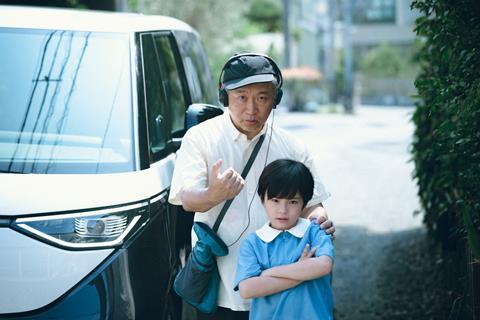
Can you talk about reuniting with Haruka Ayase and casting comedian Daigo in his first major film role.
It’s been a while since [Ayase and I] have done a full-length film together, but we’ve done some live readings and commercials in the meantime, so we’ve seen each other regularly. Sheep In The Box was conceived with her in mind. Daigo has a very human quality about him — it’s rare to find Japanese actors with that kind of face these days. Watching him on TV, I had a gut feeling he would be good.
I wanted to explore how two different elements can coexist — much like the combination of glass and wood in the architecture in the film. In that sense, I chose them because, when placed side by side, they created a striking contrast.
What does Cannes mean to you?
It’s been 25 years since I first went to Cannes [with 2001’s Distance], which is almost my entire filmmaking career, so I’m grateful to be able to hold the world premiere there. It’s a precious experience, and I have nothing but gratitude. I still get nervous every time, though. It can be a tough crowd.
Japan had a record year at the box office in 2025, but non-franchise films are having a tougher time breaking through. What are your thoughts on the state of the industry?
Original, auteur-led projects rarely come to fruition, and when they do, they end up being very small-scale. I’ve long wanted to change that situation, so my top priority as a director is to ensure we can bring such projects into being and establish a solid production infrastructure.
The fact the Japanese box office has made such a strong recovery after the pandemic is remarkable. While we’re in this period of strong performance, I believe the industry should consider what steps it could take with an eye towards the next 10 or 20 years.






No comments yet