










The second feature from Peter Meister will release in Germany in August following plays at Munich and Shanghai
Dir/scr: Peter Meister. Germany. 2026. 94mins
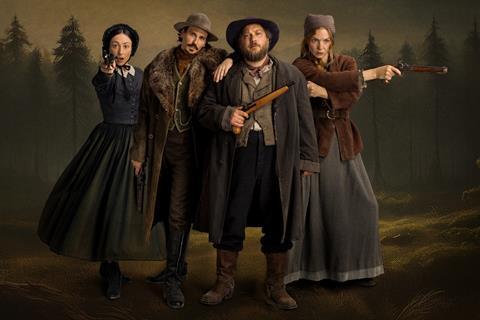
A small rural village in the German Grand Duchy Of Hesse, 1843, in the tumultuous aftermath of the Napoleonic wars. A large proportion of the townsfolk are traipsing around the nearby forest, hunting for a marauding bear that will net its killer the princely sum of 5,000 gilders. Except the animal is not a bear but a scapegoat, invented by the local rulers to explain away the sheep rustling and rising violence at the hands of the unhappy proletariat. Peter Meister’s period comedy gets some humorous mileage out of its timely riffs on corrupt leadership and the power of fake news, but, despite enthusiastic performances and some lovely period details, its gentle tone rather takes the edge off its satirical bite.
Its gentle tone rather takes the edge off its satirical bite
This is Meister’s second feature following 2021’s The Black Square, an equally absurdist comedy about art thieves trapped on a cruise ship. Bearhunting premiered in both Munich’s New German Cinema strand and at Shanghai Film Festival and will release in Germany in August through Port au Prince. It should do solid business on home soil, but its historical and cultural specificity may limit onward travel – even if its themes do ring uncomfortably true for a modern audience.
‘Peace to the huts! War to the palaces!’ shouts the front page of the underground revolutionary paper printed in the village – words taken from the real-life German activist Georg Buchner, who was distributing his manifesto pamphlets in 1834. Indeed, this story is based on real events, although it is played largely for laughs rather than historical accuracy.
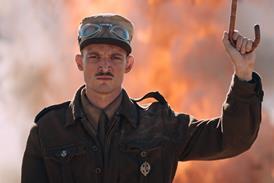
The printer of the revolutionary paper is Heinrich (David Scheid), an Austrian transplant in the village who is attempting to stoke an uprising against the ruling classes, but is somewhat distracted by the affair he is having with former actress Minna (Aenne Schwarz) – the wife of his own brother Gustav (Christopher Scharf). The sycophantic, mealy-mouthed Gustav is the printer of the community’s official newspaper, which has become a mouthpiece for the smarmy, ridiculously behatted Major-General (Bernhard Schutz) and the oppressive edicts that come down on high from the Grand Duke, who is still attempting to unite all of the country’s disparate territories.
Things are further complicated by the fact that the Major-General has designs on Heinrich’s wife Agnes (Pheline Roggan), and a spate of bloody violence is riling up the locals. Desperate to keep them under control, the Major-General invents a story about a bear and offers a handsome bounty to anyone who can kill it.
Production designer Manfred Doring and cinematographer Florian Mag do sterling work with this village setting, the homes basic but warm, the church an imposing landmark, the surrounding forest lush and green. Indeed, much of the film involves this intertwined cast of characters stumbling around the trees, accidentally shooting each other or falling into traps they themselves have set, all set to a rousing part-folk, part-punk soundtrack from The Dusseldorf Dusterboys.
These men are as much motivated by greed (or, perhaps more fairly, desperation) than fear and, amidst their rising hysteria, are completely unable to see they are being manipulated. A sheep tied impassively to a tree throughout acts as one of several unsubtle metaphors.
The women are more savvy, and can see through the ruse. Minna prefers to spend her time dreaming of a new life in America – another ironic note – in a cloud of opiate smoke, while the gun-toting Agnes (whose Calamity Jane get-up plays into the film’s Western stylings) cares only for the safety of her teenage son. These two characters are the most interesting of the piece and the most underused, the focus largely on the bumbling buffoons on both sides of the power divide. And while these themes of misinformation, damaging political rhetoric and the class divide are universal and timeless, it’s perhaps the case that some of the film’s humour is lost in translation.
Production companies: Frisbeefilms
International sales: Frisbeefilms info@frisbeefilms.com
Producers: Manuel Bickenbach, Alexander Bickenbach
Cinematographer: Florian Mag
Production design: Manfred Doring
Editing: Jan Ruschke
Music: The Dusseldorf Dusterboys.
Main cast: David Scheid, Bernhard Schütz, Aenne Schwarz, Pheline Roggan, Christopher Schärf






No comments yet