








Black-and-white Cannes Competition title follows Nobel-winning author Thomas Mann and his daughter Erika
Dir. Pawel Pawlikowski. Poland/Germany/Italy/France 2026. 82mins
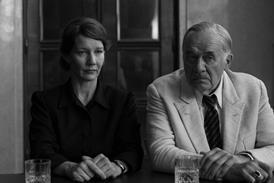
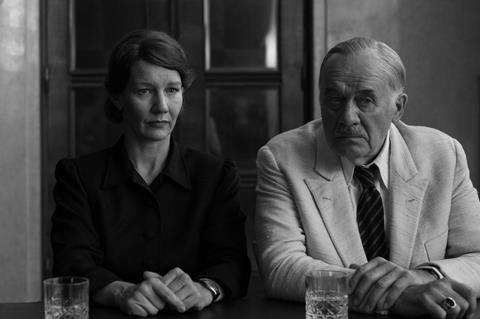
In period drama Fatherland, Polish writer-director Pawel Pawlikowski achieves a film that, in essence, is imposingly heavyweight, yet is executed with rare lightness (not to say concision, at a refreshing 82 minutes). Fatherland revolves around a figure who could hardly be more daunting: Nobel-winning German writer Thomas Mann, author of The Magic Mountain, Death in Venice et al. But Mann is here seen alongside his daughter and assistant Erika Mann (Sandra Hüller), whose presence – supportive but critically challenging - gradually, inexorably chips away at the lofty monolith that he represents.
Imposingly heavyweight, yet executed with rare lightness
With a finely honed script that gives due regard to matters political, historical and literary, this quietly intense piece may come across as a somewhat specialised affair compared to Pawlikowski’s more immediately accessible Ida and Cold War. But the ever-compelling presence of current international favourite Sandra Hüller, just a few months after her Berlin Silver Bear win for period drama Rose, should boost appeal beyond those sectors of the arthouse circuit that crave cultural and cerebral heft.
A slow-burning long-take prelude shows Mann’s novelist son Klaus Mann (August Diehl) in his bedroom in Cannes in a state of undress and despair, on the phone to sister Erika (Hüller). We then see briefly see Erika in Los Angeles, where she and her father now live – the Great Man hidden for now behind his study door.
The main action takes place in Germany in 1949, with Thomas and Erika returning to the old country for the first time. They arrive in Frankfurt, in the newly demarcated West, where Mann (German screen doyen Hanns Zischler) is to be awarded the prestigious Goethe Prize. In Germany, he is both revered and condemned, the latter for emigrating to the US years before and, as some see it, abandoning his fatherland, while in America he is suspected of Communist sympathies. At award celebrations in a hotel’s swanky marble halls, everyone wants a piece of the maestro (international journalists, the CIA, the grandsons of composer Richard Wagner), while Erika has a brittle encounter with her ex-husband, actor Gustaf Gründgens (Joachim Meyerhoff) – a darling of the Nazi regime and the inspiration for Klaus’s novel Mephisto.
During their visit, father and daughter receive earth-shattering news – but, to Erika’s dismay, Thomas retains a stern, august exterior and insists on continuing with their planned trip to Weimar in the East, associated with the Romantic poet Goethe. There they are welcomed by writer Johannes Becher (Devid Striesow), an enthusiastic supporter of the new Soviet-run order, and by a solemn, military-dominated audience, as Mann delivers a speech on, among other themes, Goethe’s conception of love.
Pawlikowski and co-screenwriter Henk Handloegten (Paul Is Dead, TV series Babylon Berlin) deliver a highly literate script packed with cultural references (art, poetry, music) and using passages from Mann’s speeches. The script achieves a dense interweaving of themes: idealism and its delusions; familial relationships; the nature of nationality and home; the Cold War race to capitalise on cultural heritage; the once-untouchable status assigned to eminent male artists; the Faust legend, as elaborated by both Mann and Goethe.
Alongside its verbal and intellectual content, Fatherland is immersively evocative, genuinely making us feel as if we are visiting the two Germanies in 1949. DoP Lukasz Zal shoots in black and white in Academy ratio, in a signature style that makes Fatherland very much of a piece with the similarly period-based Ida and Cold War (the latter’s star Joana Kulig has a featured cameo as a chanteuse). The visuals evoke parallels and contrasts (two podium appearances in different settings; the hedonistic bustle of the Frankfurt date versus the austere Eastern trip), as well as giving weight to spaces and textures: a montage of moss-covered statues, the ruined church where the film reaches a subtly cathartic conclusion.
Zischler gives Mann a central core of tragic awareness, as a man who protects his emotions under a carapace of Olympian gravitas, while Hüller gives another exceptional performance. Her Erika – herself a writer, actor and accomplished war correspondent – here seems to play subservient factotum to her father, but reveals flashes of anger and ironic humour, and increasingly tests him with both devotion and defiance. Diehl, meanwhile, his haggard eyes never more eloquent, hits a nerve as a man quietly vibrating with despair.
Music by Bach, Mozart and Messaien, plus period jazz songs and a glum Socialist anthem – written by Bertolt Brecht’s sometime composer Hanns Eisler – add further colour to this coolly confident, undemonstratively masterful film.
Production companies: Our Films, Extreme Emotions, Nine Hours, Chapter 2
International sales: The Match Factory info@matchfactory.de
Producers: Mario Gianani, Lorenzo Mieli, Ewa Puszczynska, Jeanne Tremsal, Edward Berger, Dimitri Rassam, Lorenzo Gangarossa
Screenplay: Pawel Pawlikowski, Henk Handloegten
Cinematography: Lukasz Zal
Production design: Katarzyna Sobanska, Marcel Slawinski
Editing: Pawel Pawlikowski, Piotr Wójcik
Music: Marcin Masecki
Main cast: Sandra Hüller, Hanns Zischler, August Diehl, Devid Striesow