







Susanne Heinrich’s follow-up to ‘Aren’t You Happy?’ plays Munich’s New German Cinema strand
Dir/scr: Susanne Heinrich. Germany. 2026. 81mins
Taking an absurdist Brechtian approach to the challenges of early parenthood, musical The Miserable Mother is a playful and lively reflection on the existential challenges of the postpartum period. It forms the second part of director Susanne Heinrich’s female subjectivity trilogy, which deals with the condition of womanhood in late capitalism, following 2019’s Aren’t You Happy? (the final chapter, The Outdated Woman, is in development).
A keen sense of fury, awe and mischief.
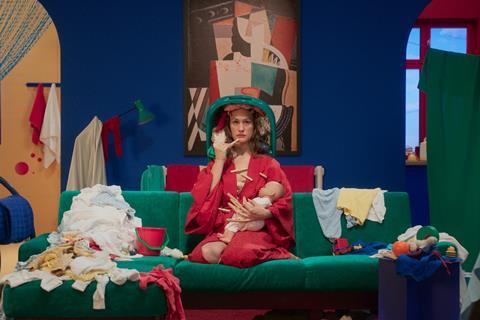
The eponymous Miserable Mother (relative newcomer Rosa Landers in her biggest role to date) has recently given birth and is immersed in the new rhythms of her life as mother to a young baby. Her partner, Peter Pan (Theo Colarusso) is doing his best – but is it really his best? He dances around her anger – literally. In addition to being influenced by Brecht’s philosophy of making the familiar strange in order to fully see it, the grand tradition of German cabaret is alive and well in the enjoyably excoriating and original film, which now plays Munich after premiering in Shanghai.
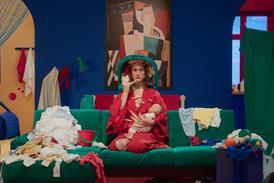
Vividly art directed on a modest budget and choreographed with flair, the action unfolds in several key settings: the mother and baby cafe; the detritus-strewn living room of the family’s apartment; the park where prams are pushed, day in, day out. Production designer Miren Oller reimagines these locations as stylized spaces, in bright blocked-out colors, all vivid greens and reds, where mothers (costumed with similar zest by Laura Yasemin Schäffler) go through robotic clockwork motions. This is technicolour German expressionism, with a similar sense of the nightmarish – the cot of Dr Caligari, if you will.
Chapter titles indicate the line of enquiry for each section but, despite meaty and potentially indigestible concerns such as the ’politicisation of the private… or privatisation of the political?’, the film’s messaging is easy to swallow. Heinrich has an ear for the kinds of phrases that permeate modern motherhood and is keenly attuned to the ironies inherent in many widely parroted yet questionable directives (“What’s good for the mother is good for the baby”).
As is traditional, the babies in the film are mostly played by dolls – unusually, however, the audience is meant to notice the infants aren’t real, the overt use of dolls creating a structuring absence. This allows the film to look at what is happening around, and as a result of, this child, without scrutinising the child itself. Then, for certain key scenes, real babies and children are employed; in these moments, we are invited to contemplate the small human being at the heart of the routines and rituals.
Not an awful lot happens, in the traditional sense of movie narrative. Peter Pan disappears at one point for several months, he feels overwhelmed by the challenge of adjusting to his new role, and prioritises his belief that he needs time and space – a luxury unavailable to his partner. Up until this point, he is presented as the sort of man who, because he has changed some nappies and read some parenting books, can feel morally superior while delivering the bare minimum.
Peter Pan does return later, but the plot is not really what is fuelling the engine here. This is an immersive polemic wrapped in stagecraft, its focus is the thought-patterns, conflicts and routines unfolding during a seismic shift in identity. Heinrich is interested in the collision of utterly banal duties and concerns (for example: the consistency of baby poo) with a profound and fundamental realignment of the self.
One chapter in particular excavates the way in which parenting can completely gut and rewire a person’s capacity for love and joy – an experience that is both ecstatic, because of the surreal intensity of the new versions of those emotions, and alarming, because of the way that previous instances of those emotions are rendered almost comically insignificant. It is a pleasure to watch Heinrich navigate this territory with such a keen sense of fury, awe and mischief.
Production company: Reynard Films GmbH, Coproduction Office katharina@reynardfilms.com
International sales: Reynard Films post@reynardfilms.de
Producer: Katharina Weser, Philippe Bober
Cinematography: Agnesh Pakozdi
Editing: Clémentine Decremps
Music: Willi Sieger
Sound: Niklas Kammertöns
Main cast: Rosa Landers, Theo Colarusso, Johanna Spantzel, Julia Klotz