



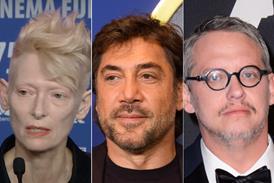


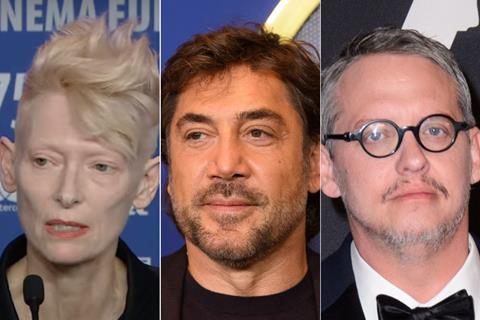
Tilda Swinton, Javier Bardem and Mike Leigh are among over 80 current and former Berlinale participants to have signed an open letter, criticising the festival for “censoring artists who oppose Israel’s ongoing genocide against Palestinians in Gaza and the German state’s key role in enabling it.”
“We write as film workers, all of us past and current Berlinale participants, who expect the institutions in our industry to refuse complicity in the terrible violence that continues to be waged against Palestinians,” said the statement. “We are dismayed at the Berlinale’s involvement in censoring artists who oppose Israel’s ongoing genocide against Palestinians in Gaza and the German state’s key role in enabling it.”
Scroll down for the full statement
“The Berlinale has so far not even met the demands of its community to issue a statement that affirms the Palestinian right to life, dignity, and freedom; condemns the ongoing Israeli genocide of Palestinians; and commits to uphold the right of artists to speak without constraint in support of Palestinian human rights,” continued the statement. “This is the least it can – and should – do.”
Further names to have signed the statement include The Big Short writer-director Adam McKay, Succession star Brian Cox, Wuthering Heights actress Alison Oliver, and I Swear actor Peter Mullan.
“Just as the festival has made clear statements in the past about atrocities carried out against people in Iran and Ukraine, we call on the Berlinale to fulfil its moral duty and clearly state its opposition to Israel’s genocide, crimes against humanity and war crimes against Palestinians, and completely end its involvement in shielding Israel from criticism and calls for accountability,” ends the statement.
All of the guests have previously attended the Berlinale or are at this year’s event. Swinton received an honorary Golden Bear at last year’s festival, when she made a fiery speech calling out “state-perpetrated crimes”.
It continues the controversy that began at the festival’s opening Competition jury press conference. Jury president Wim Wenders responded to a question about the festival’s stance on “the genocide in Gaza” by making a distinction between the work of filmmakers and that of politicians, saying “we are the counterweight to politics. We are the opposite of politics.”
Festival guests including Michelle Yeoh, Neil Patrick Harris and Rupert Grint were all asked questions about specific political issues, with many choosing not to make explicit political statements. Indian author Arundhati Roy cancelled an appearance at the festival in protest at Wenders’ comments, with festival director Tricia Tuttle then writing a statement in response to the controversy.
“Artists are free to exercise their right of free speech in whatever way they choose,” said Tuttle’s statement. “Artists should not be expected to comment on all broader debates about a festival’s previous or current practices over which they have no control.”
The Berlinale runs until Sunday, February 22.
Open Letter to the Berlinale:
We write as film workers, all of us past and current Berlinale participants, who expect the institutions in our industry to refuse complicity in the terrible violence that continues to be waged against Palestinians. We are dismayed at the Berlinale’s involvement in censoring artists who oppose Israel’s ongoing genocide against Palestinians in Gaza and the German state’s key role in enabling it. As the Palestine Film Institute has stated, the festival has been “policing filmmakers alongside a continued commitment to collaborate with Federal Police on their investigations”.
Last year, filmmakers who spoke out for Palestinian life and liberty from the Berlinale stage reported being aggressively reprimanded by senior festival programmers. One filmmaker was reported to have been investigated by police, and Berlinale leadership falsely implied that the filmmaker’s moving speech – rooted in international law and solidarity – was “discriminatory”. As another filmmaker told Film Workers for Palestine about last year’s festival: “there was a feeling of paranoia in the air, of not being protected and of being persecuted, which I had never felt before at a film festival”. We stand with our colleagues in rejecting this institutional repression and anti-Palestinian racism.
We fervently disagree with the statement made by Berlinale 2026 jury president Wim Wenders that filmmaking is “the opposite of politics”. You cannot separate one from the other. We are deeply concerned that the German state-funded Berlinale is helping put into practice what Irene Khan, the UN Special Rapporteur on Freedom of Expression and Opinion recently condemned as Germany’s misuse of draconian legislation “to restrict advocacy for Palestinian rights, chilling public participation and shrinking discourse in academia and the arts”. This is also what Ai Weiwei recently described as Germany “doing what they did in the 1930s” (agreeing with his interviewer who suggested to him that “it’s the same fascist impulse, just a different target”). All of this at a time when we are learning horrifying new details about the 2,842 Palestinians “evaporated” by Israeli forces using internationally prohibited, U.S.-made thermal and thermobaric weapons. Despite abundant evidence of Israel’s genocidal intent, systematic atrocity crimes and ethnic cleansing, Germany continues to supply Israel with weapons used to exterminate Palestinians in Gaza.
The tide is changing across the international film world. Many international film festivals have endorsed the cultural boycott of apartheid Israel, including the International Documentary Festival Amsterdam, the world’s biggest, as well as BlackStar Film Festival in the U.S., and Film Fest Gent, Belgium’s largest. More than 5,000 film workers, including leading Hollywood and international figures, have also announced their refusal to work with complicit Israeli film companies and institutions.
Yet Berlinale has so far not even met the demands of its community to issue a statement that affirms the Palestinian right to life, dignity, and freedom; condemns the ongoing Israeli genocide of Palestinians; and commits to uphold the right of artists to speak without constraint in support of Palestinian human rights. This is the least it can – and should – do.
As the Palestine Film Institute has said, “we are appalled by Berlinale’s institutional silence on the genocide of Palestinians, and its unwillingness to defend the freedoms of speech and expression of filmmakers”. Just as the festival has made clear statements in the past about atrocities carried out against people in Iran and Ukraine, we call on the Berlinale to fulfil its moral duty and clearly state its opposition to Israel’s genocide, crimes against humanity and war crimes against Palestinians, and completely end its involvement in shielding Israel from criticism and calls for accountability.

No comments yet