



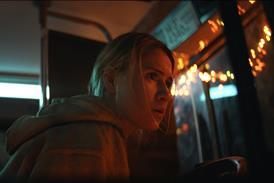
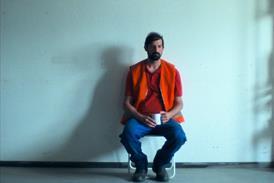







Berlin Perspectives title from Israeli filmmaker Assaf Machnes features strong performances from Ehab Salami and Ido Tako
Dir/scr: Assaf Machnes. Israel/Germany. 2026. 95mins
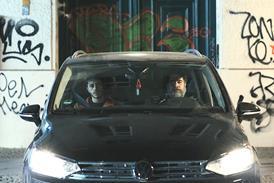
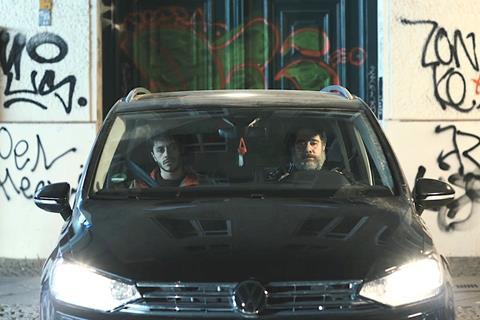
Much of the action of writer/director Assaf Machnes’s delicate, funny debut feature takes place inside the car of taxi driver Hassan (Ehab Salami), a 50-something Palestianian who works the Berlin night shift, ferrying people to and from restaurants, nightclubs, parties and the airport. ‘Action’, however, is not the right word. This is a film about about things said and not said, about shared languages and feelings, and deep divisions.
Responds with passion and humanity to heated national debates
At the core of this quiet gem is the unlikely father-son rapport that develops between Hassan and passenger Amir (Ido Tako) a young, gay Israeli man, over the course of two years. “I like you”, Hassan tells Amir towards the end of the film, “and this is a problem”.
The real strength of Where To? lies in its knack for conveying deep, complex personal and political tensions with simple words, gestures or glances. With dialogue mostly in stilted English, accompanied by snatches of Arabic, Hebrew, German and Greek, this small, resonant drama responds with passion and humanity to heated national debates in both its co-production territories, Israel and Germany, but it will also talk to open-minded audiences worldwide. In the end, this is a story about shared heartbreak, not about walls and fences. It’s a worthy addition to the taxi-film mini genre, alongside the likes of Jafar Panahi’s Taxi and Jim Jarmusch’s Night on Earth.
Where To? is perceptive about the illusion of connection that ride-hailing apps bring: we know the driver’s name, they know ours, but that’s as far as it goes. The story begins when fresh-faced Amir gets into the back of Hassan’s car with his hot German boyfriend. They very nearly make out on the back seat, as Hassan glances nervously in the rear-view mirror. Acting mostly with his expressive face, Salami conveys a mix of nervousness, cautious hope, buried trauma and repressed passion in a magnetic performance.
The film consists of ten episodes spanning two years, from May 2022 to May 2024. Most but not all feature rides and passengers; only three see Hassan leave the cocoon of his cab for any length of time. He is married, it transpires, and has three daughters; one, rejecting her parents’ traditional values, has left home and has a non-Muslim German boyfriend. Hassan’s feelings about this, and his own complex sense of where he belongs and what he values, are teased out slowly.
The second time Amir gets into Hassan’s cab, it’s by chance. Though both are curious about each other, there’s a cultural and political crackle too: Amir comes from Galilee, which is where Hassan’s family lived before they were driven out during the Nakba – the forced displacements of 1948. Amir has a talent for direct questions, and the imperfect English both men speak reduces their initally casual conversation to those unavoidable essentials that can define a whole life: “Why you move here?” “Why you want to go back?”. These brief meetings with a young man who is literally and metaphorically from the other side, but with whom he feels an affinity, become the catalyst for Hassan to dig up a secret from his own past.
These meetings are separated by scenes of other nights, other passengers, some with a wrily comic tone – at its sharpest in a scene in which Hassan pickes up an older Israeli couple of tourists while he’s having a hands-free phone conversation with his cousin. Hearing them speaking Hebrew in the background, the cousin begins to perform a wind-up routine, peppering his chat with phrases like ‘Allahu Akbar’. “This is what happens when you try to save on taxi fares”, the woman hisses to her husband.
A series of delicate, wistful woodwind and piano melodies by Palestinian musican Habib Hanna Shehadeh act as chapter dividers. Shot entirely at night, with an extensive use of shallow-focus that at times turns the city outside the cab into a piece of abstract video art, Where To? becomes a poigant portrait of imperfect lives, frustrated by history, prejudice, bad decisions, that are nevertheless worth trying to get back on the right track.
Production companies: 2-Team Productions, Rogovin Brothers, Iconoclast Films, Lev Cinemas
International sales: Lucky Number sales@luckynumber.fr
Producers: Tomer Mecklberg, Estee Yakov-Mecklberg, Haim Mecklberg, Oren Rogovin, Dennis Schanz, Luis Singer, Julia M. Muller, Guy Shani
Cinematography: Maayane Bouhnik
Production design: Kristina Schmidt
Editing: Or Lee-Tal, Shauly Melamed
Music: Habib Hanna Shehadeh
Main cast: Ehab Salami, Ido Tako, Milan Peschel, Rama Nasrallah, Raheeq Haj Yahia-Suleiman