



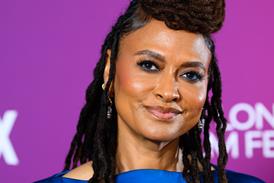








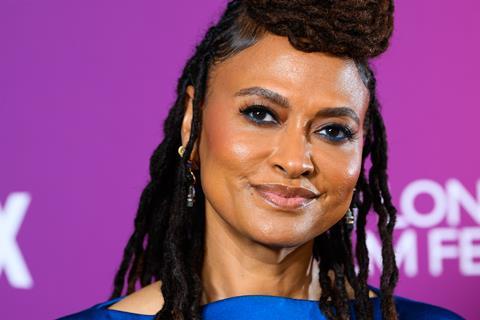
US filmmaker Ava DuVernay has asserted that the onus is now on filmmakers to connect directly with audiences, instead of using traditional business chains of studios, sales and distribution.
“Hollywood is over,” said DuVernay in her Screen Talk at BFI London Film Festival, where her documentary 14th has its international premiere. “Did you guys hear? It’s done. [The studios] are buying each other; they’re collapsing. It’s all changed. They’re selling studio lots.
“The idea of going to Sundance and getting a three-picture deal from Harvey Weinstein? He’s in prison.”
DuVernay said the breakdown of the traditional Hollywood system is being replaced by a more direct link between storytellers and the audience.
“What used to happen is it was artists, a company, that connected you and the audience. You had to have all three. Now that middle piece is done,” said the filmmaker. “So it’s just the audience and the artist. We have to find a way to find each other. You can think of that as, wow, it’s all over. What do we do now? Or what can we build now that’s new that serves more kinds of people and kinds of stories?”
Rather than chasing traditional studio backing, she urged creators to pool community capital to get their projects made. “For more independent filmmakers, I would just really urge us to try to find each other,” said DuVernay. “Bring together 20 people willing to invest $5,000 each, and you generate $100,000 towards a film.”
Reception
14th had its world premiere last week as the closing night film of New York Film Festival. Serving as a companion piece to her 2016 documentary 13th, the film details the history of the 14th amendment to the US Constitution, exploring ongoing debates over birthright citizenship, equal protection and the legal definition of citizenship.
DuVernay also took aim at distribution biases within the US system that she believes restrict the international reach of Black cinema. She challenged the persistent narrative she said is told to American creators that European audiences lack interest in “the African American experience”.
“We’re told in the United States that [non-Americans] don’t care about what we do over there – that [Black American] films don’t travel overseas,” said DuVernay. “We’re told we don’t have a wide distribution in Europe because there is a lack of interest. But when I come here, I’m always warmly received, and I am often so surprised.”
The director also reflected on her practice of integrating full-time mental health professionals into production workflows on 2019 series When They See Us, as another form of challenging industry paradigms.
“The first thing I want to do is care for everyone on the set because as you’re watching, it’s not just about the actors,” said DuVernay. “The crew is watching people be abused in cells and hit in rooms. When you go home, your body doesn’t know the difference between acting and what’s real. Having crew members drive home at two in the morning feeling that, we made sure there were mental health professionals available at any time.”
DuVernay said that she used the production of 14th to process personal terror regarding real-time immigration enforcement sweeps outside her Los Angeles office. “This film saved me in a lot of ways,” said the director. “The rage and fear that I feel, I was able to pour into 14th every day. I only finished the film two weeks ago, so I really don’t know what I’m going to do from here.”
For audience members who might be feeling pessimistic about the state of the world, DuVernay said, “You have to be active if you want to get rid of this feeling of just ick and hopelessness.
“Fifty years ago, there was no one like me making films like this. I didn’t have the privilege to be bothered or scared making the film. Knowing history and leaning into it and doing something in the present moment, whatever it is. It has to be more than sitting and watching and complaining. Use the energy, turn it into something imaginative. I hope the film helps us, the people, remember our power.”
Netflix will release 14th in select US and UK cinemas on November 27, 2026, ahead of its global streaming launch on December 4, 2026.
The BFI London Film Festival continues until Sunday, October 18.




No comments yet