




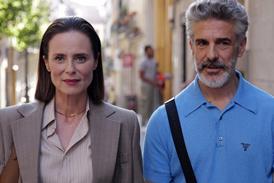











The director’s latest work stars several of his regular collaborators including Leonardo Sbaraglia and Aitana Sánchez-Gijon
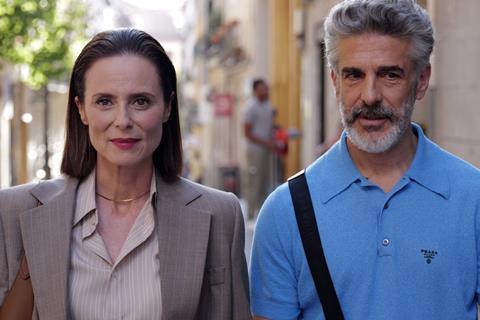
Dir/scr: Pedro Almodóvar. Spain. 2026. 111mins
Multi-layered, cunningly crafted, melodramatic to a fault and interestingly unseasonal despite its title, Pedro Almodóvar’s intensely personal, self-conscious Spanish language Bitter Christmas is a return to a cinematic world which, over his 23 previous features, the director has made his own. Effectively rolling two films into one – the first about a film director writing a script, and the second based on the script he is writing about another film director – Bitter Christmas’ revelatory exploration of the tricky relationship between perfect artistic creation and the messiness of life sometimes feels just as sealed-off and tangled as that summary makes it sound.
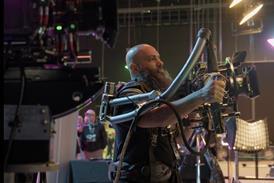
The focus is clearly on Almodóvar himself
Bitter Christmas opened in Spain on March 20 and, with several of his previous films having premiered on home turf before heading to Cannes, it remains to be seen whether this will follow in their footsteps to the Croisette. Curzon will distribute in the UK/Ireland, and the film will also have a streaming release on Spain’s Movistar Plus+.
As with 2019’s quasi-autobiographical Pain and Glory, the focus of Bitter Christmas is clearly on Almodóvar himself, this time split between two surrogates whose stories the script smoothly moves between. The first is director Raul (Argentinian actor Leonardo Sbaraglia), who is struggling to make headway with a screenplay, chunks of which regularly appear in bold colours on the screen. His friend and long-time assistant Monica (Spanish veteran Aitana Sánchez-Gijon) decides that she will take a break to go and tend to an ill friend. Crucially for the plot, Monica takes with her a copy of Raul’s new screenplay to read.
Raul’s screenplay for ‘Bitter Christmas’ is set in 2004, and features a far more populous and intricately woven storyline. Its protagonist Elsa (Barbaba Lennie) is Almodóvar’s second surrogate, a ‘cult’ director who has moved into advertising and who suffers a panic attack which leads to a break from work. Elsa is also plagued by migraines and, perhaps even more than Pain And Glory, Bitter Christmas is an extended catalogue of its characters’ various illnesses and anxieties.
Elsa’s boyfriend and emotional support is the unimpeachably caring Bonifacio, or ‘Beau’ (Patrick Criado), a fireman and male stripper. Predictably if entertainingly enough, we are treated to a full strip routine by Beau, to the accompaniment of Grace Jones – a throwback to Almodóvar’s more fun, less-PC side, which seems largely to have gone missing since 2013’s I’m So Excited.
Patricia (Vicky Luengo), a friend of Elsa’s, has her own reasons for being in a permanent state of anxiety – amongst them that she believes her husband is having an affair in Paris. Like the protagonists of earlier Almodóvar films, Elsa and Patricia’s eyes go misty in Patricia’s gorgeous flat as they listen to a late performance of a ranchera by Almodóvar’s friend, the late Mexican singer Chavela Vargas – a great chronicler of women’s suffering.
“The ending of a story sometimes imposes itself without the writer controlling it,” one character observes, in one of several sharp apercus about the making of movies. And indeed, as Raul continues to write his screenplay, and as the film of that screenplay unfolds before the viewer’s eyes, the key theme of Bitter Christmas emerges, asking what right an artist has to plunder the emotional lives of those nearest to them in the name of their art. That is explored in a memorably raw showdown between Raul and Monica, which fascinatingly dissects the flaws and limitations of Raul’s attitude and screenplay (which are, of course, also Almodóvar’s).
This courageous, clear-eyed critique by the late-period Almodóvar of his own work signals a thematic move into new territory for him. Stylistically, though, Bitter Christmas could be accused of the complacency of which Monica also accuses Raul: as the credits boldly state, this can only be ‘a film by Almodóvar’. That’s evident in cameos from Almodóvar regulars Rossy de Palma and Carmen Machi, who bring a gentle humour to the early scenes which is then extinguished in a tidal wave of intensity; its celebration of Madrid culture; and its impeccably arranged and richly-hued interiors.
Then we have its use of exquisitely conceived though sometimes overwrought visuals, perhaps most strikingly in DoP Pau Esteve Birba’s rendering of the alien, lunar landscapes of the island of Lanzarote. It’s here that Monica rediscovers her own creative mojo in the company of her friend Natalia (Milena Smit). Alberto Iglesias’s busy orchestral score feels omnipresent.
What’s missing, beyond a few social references to the early 2000s, is anything outside the frame of this Almodóvar-centred world. The multiple psychological and physical sufferings of the characters seem to unspool in a hermetically sealed bubble, and some of the characters themselves feel surplus to dramatic requirements. Such an inward-looking approach might, in directors of lesser stature, be described as merely navel-gazing, but at least the 76-year-old Almodóvar still makes this an interesting process. That said, Bitter Christmas remains a cinephile’s film – one whose exploration of emotions ultimately fails to translate into an emotional experience for the viewer.
Production companies: El Deseo, Movistar Plus+
International sales: Film Factory Entertainment info@filmfactory.es
Producers: Agustín Almodóvar, Esther García
Cinematography: Pau Esteve Birba
Production design: Antxon Gomez
Editing: Teresa Font
Music: Alberto Iglesias
Main cast: Leonardo Sbaraglia, Aitana Sanchez-Gijon, Barbara Lennie, Patrick Criado, Vicky Luengo, Quim Gutierrez, Milena Smit