




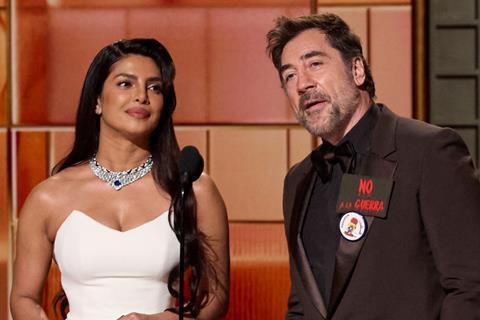
Javier Bardem saying “No to war, and free Palestine” and Jimmy Kimmel’s Donald Trump jokes stood out as the political moments amid a largely good-natured Oscars 2026 ceremony.
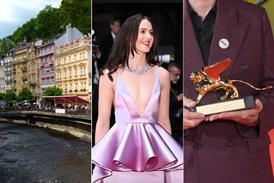
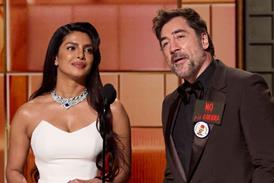
Presenting the best international feature film award alongside Priyanka Chopra Jonas, Bardem immediately made his comment on Palestine, before launching into the award presentation. His words were met by a largely positive reaction from the room, including cheers from the audience and a slight nod from Chopra Jonas beside him.
A vocal critic of Israel’s military campaign in Gaza, Bardem wore a large badge with the Spanish words ‘No a la Guerra’ (translation: no to war), and another badge representing Palestine.
His call was the most overtly political incident in the 2026 Oscars, coming around three-quarters of the way through the ceremony.
Earlier, while presenting best documentary feature, Jimmy Kimmel made jokes about US president Donald Trump and his wife Melania.
“There are some countries whose leaders don’t support free speech,” said Kimmel, who himself has hosted the Oscars on four occasions, in 2017, 2018, 2023 and 2024. “I’m not at liberty to say which. Let’s just leave it at North Korea and CBS.” US network CBS was accused of censorship last year after pulling a 60 Minutes broadcast at a late stage.
Kimmel went on to praise documentary filmmakers for their bravery. “There’s an international community of filmmakers dedicated to telling the truth, oftentimes at great risk. To make films that teach us, that call out injustice, that inspire us to take action.
“And there are also documentaries where you walk around the White House trying on shoes,” quipped Kimmel, referencing Brett Ratner’s 2026 Amazon MGM Studios documentary Melania about First Lady Melania Knauss.
“Oh man, is he going to be mad his wife isn’t nominated,” joked Kimmel, without naming Trump himself.
Other presenters and awardees made political references without citing specific targets, including Joachim Trier, whose Sentimental Value took the best international feature prize presented by Bardem and Chopra Jonas.
After praising his fellow nominees and highlighting the vitality of international cinema, Trier said, “All adults are responsible for all children. Let’s not vote for politicians who don’t take this seriously and into account.”
Paul Thomas Anderson won three awards himself for One Battle After Another, as part of six awards for the film. Anderson kept his speeches largely apolitical, although he did mention the state of the world when accepting the best adapted screenplay prize.
“I wrote this movie for my kids to say sorry for the housekeeping mess that we left in this world we’re handing off to them,” said Anderson. “But also with the encouragement that they will be the generation that hopefully brings us some common sense and decency.”
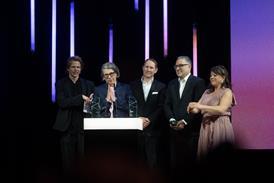
One of the strongest speeches in the evening came from David Borenstein, writer, co-director and producer of documentary feature winner Mr. Nobody Against Putin, which is made of footage of Russian school propaganda shot undercover by teacher Pavel Talankin.
“[The film] is about how you lose your country, and what we saw when working with this footage is that you lose it through countless small, little acts of complicity. When we act complicit, when a government murders people on the streets of our major cities, when we don’t say anything, when oligarchs take over the media and control how we can produce it and consume it, we all make a moral choice,” said Borenstein to huge applause from the room. “But luckily, even a nobody is more powerful than you think.”
Celebratory
Despite these political instances, much of the evening passed without controversy and had a celebratory tone.
O’Brien made jokes about “preserving film history… for the smartphone generation” through a fictional group of film preservationists called Ventura Crossroads Labs. The ceremony then played a video skit of classic films cut to a thin portrait aspect ratio.
Standing ovations are de rigeur at the Academy Awards. This year, such acclaim was afforded twice to Michael B. Jordan in accepting his best actor prize – first when he took to the stage, then again when he departed, with his fellow nominees including previous frontrunner Timothée Chalamet among those on their feet.
One winner who might have been expected to take a political stance was Sean Penn, winner of best supporting actor for One Battle After Another. However, Penn’s anticipated absence from the ceremony left it to last year’s winner and this year’s presenter Kieran Culkin to make light of the situation.
“Sean couldn’t be here this evening – or didn’t want to – so I’ll be accepting the award on his behalf,” joked Culkin. Penn was in Ukraine meeting with president Volodymyr Zelensky.
Actors Bill Pullman and his son Lewis Pullman riffed on nepotism in presenting the best editing prize. “All on your own, you did just fine,” said Bill, with Lewis responding, “We’re lucky – turns out audiences don’t always mind the sequel.”
Boos for ‘playing off’ music
As in previous years, several winners were unceremoniously played off by the orchestra due to time constraints, with particular unhappiness in the room when one of the team from best song winner ‘Golden’ had his speech cut almost entirely for the next commercial break.
However, one winner fought back: Alexandre Singh, co-director of best live-action short film co-winner Two People Exchanging Saliva, simply kept talking through until the sound was brought back.
Singh also gave a nod to Chalamet’s recent comments about ballet and opera being dying art forms. “We can change society through art, through creativity – through theatre and ballet – and also cinema,” said Singh.
Late in the evening, Jessie Buckley turned attention to the UK and to women after winning the best actress prize for Hamnet. “It’s Mother’s Day in the UK today, so I would like to dedicate this to the beautiful chaos of a mother’s heart,” said Buckley, who had burst into tears when her name was read out.

No comments yet