





The Venice competition title follows previous features and a 2019 art installation
Dir. Ilya Khrzhanovsky. Germany/France/Sweden 2026. 195mins
Shot over several years on a massive, citadel-like set, Ilya Khrzhanovsky’s sprawling, conceptual Dau project, which is loosely based on the biography of Soviet physicist Lev Landau, attracted early attention thanks to reports of an immersive shoot that was like its own enclosed Soviet-era eco-system. But when Dau did reach the public, in the form of an ambitious installation event in Paris in 2019, and two films screened in Berlin the following year, the effect was anti-climactic – the two features, though impressive, seeming too much like fragments of a bigger inaccessible universe. The idea of a further feature, six years on, might have seemed redundant, but the 2026 Dau, which premieres in Venice competition, truly delivers on the project’s promise.
The kind of lawless auteur craziness rarely seen in today’s narrative cinema
This film opens out the previous Dau films in imposing, exuberantly spectacular fashion. Arriving in Venice, it is likely to have as many detractors as admirers, but it’s wildly ambitious, exuding the kind of lawless auteur craziness rarely seen in today’s narrative cinema – with strains of von Trier, Kubrick and the late Russian visionary Alexei Guerman. It’s likely to be a stiff challenge for any kind of traditional theatrical exhibition – although adventurous distributors could well pitch the film as a must-see high-art event movie along the lines of, say, The Brutalist (which DoP Lol Crawley worked on after his own Dau experience).
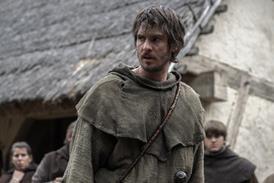
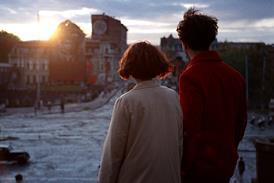
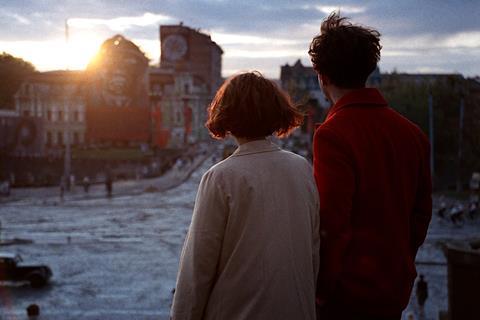
Ostensibly inspired by the life of Landau, Dau is an inquiry into Russian history, the purpose of science and knowledge, the nature of love, and the advent of the Bomb. It begins in Leningrad in 1928, where the lanky young man just known as Dau (Teodor Currentzis) is seen striding through the thronged streets – rat-infested and litter-strewn, yet teeming with energy and a sense of creative as well as destructive anarchy, as seen in the extras’ wildly coloured, stylised clothes.
Soon after comes a riotous ball with jazz orchestra and revellers in fanciful headdresses; here Dau meets Nora (Radmila Shegoleva), the young woman he is fated to marry and, eventually, to make deeply unhappy. Later, he joins a research centre where scientists are being pressured by the authorities to put their knowledge to the purposes of the state. Several object – but while some colleagues are sent to penal colonies, Dau survives a beating and lives to enlist at a research institute in Moscow, where the rest of the film takes place.
This enclosed fortress becomes both heaven and hell. Over the years, Dau and his colleagues enjoy much freedom, pursuing both abstract theory and some bizarre performance-like experiments. Dau himself enjoys an orgiastic plethora of free love and the attentions of mistresses, female ‘assistants’ and colleagues’ wives – all to Nora’s increasing misery. But the Institute’s population also lives under draconian state surveillance, in the form of a ruthless Cheka interrogator (Vladimir Azhippo).
As the film extends for four hours, and several decades, its energies work in a way that seems to reflect the dynamics of Soviet history (and, one suspects, of entropy and other thermodynamic concepts studied by Dau and his colleagues). Dau begins with a furious explosion of visual information –formulae on chalkboards, flashes of bloody flesh, shards of disconnected imagery – that recurs intermittently to a hurricane of sound design. Then comes the monumental craziness of the early sequences, with their multitudes of extras and brilliantly hued conceits – a huge mountain of cabbages, people striding along diagonally, a tower perilously scaled by crowds of half-naked men (by the looks of it, for real, rather than through VFX). But gradually the motor of spectacle runs down and the film’s world closes in, claustrophobia dominating; the colours, previously including Dau’s signature red velvet, fade to grey and a glaucous aquarium green.
Sex and violence are once again to the fore: the latter in the presence of Azhippo and the thuggish murder squad who invade the premises; sex in various in-house couplings, with just a hint of the intensely disturbing incest shown in a previous Dau. We get not one but two apocalyptic climaxes, one real, the other seemingly in the realm of dream or prophecy – a narrative arc that suggests a USSR motoring inexorably towards its own implosion along a trail of horror.
At the centre of this crazy cosmos of a film are Currentzis as the wild-eyed, wilder-haired Dau, ageing from enthused bohemian dreamer to semi-deranged libertine; and Shegoleva as the beleaguered Nora, starting as an embodiment of young 20s Soviet possibility and ending up as a matriarch, embittered but still holding onto the love of a man who, at least compared to some, has not become a total monster. Superstar artists Marina Abramovich and Carsten Holler are apparently in here somewhere, while experimental opera director Peter Sellars pays a visiting boffin flying the flag for scientific idealism. In the huge cast, every single face, whether beautiful, battered or grotesque, feels authentically of its place and time.
One emerges from Dau reeling – exhausted, exhilarated, infuriated or perplexed – but unavoidably affected. The project’s time seems as if it has truly come, not just for its dizzy monumentalist hubris, but also – since the invasion of Ukraine - for the renewed pertinence of its insights into the brutality of Russian empire building and enforcement.
Production companies: Phenomen Berlin Filmproduktions, Essential Films, Société Parisienne de Production, Platform Produktion
International sales: Phenomen Films info@phenomenfilms.com
Producers: Philippe Bober, Ilya Khrzhanovsky, Leonid Lebedev
Screenplay: Ilya Khrzhanovsky, Susanne Marian, Vladimir Sorokin, Ilya Permyakov
Cinematography: Jürgen Jürges, Manuel Alberto Claro, Lol Crawley
Production design: Denis Shibanov, Olga Gurevich, Boris Shapovalov
Editors: Ilya Permyakov, Rob Myers
Main cast: Teodor Currentzis, Radmila Shegoleva, Anatoly Vasiliev, Vladimir Azhippo