










A strong perormance from newcomer Mariam Dawoud anchors Akin’s tender Hamburg-set love story
Dir. Fatih Akin. Germany 2026. 105mins
A tender, intelligent, beautifully-crafted supernatural love story, German-Turkish writer/director Fatih Akin’s San Sebastian opener features a terrific central performance from newcomer Mariam Dawoud as a young woman who finds love after death. Set in Akin’s hometown and regular location of Hamburg, Ghost Song is emotionally satisfying piece that looks certain to chime with young audiences in Germany and beyond.
Radiant newcomer Mariam Dawoud gives her heroine both emotional and cultural complexity
Akin has had a very varied filmography, from the bohemian melodrama of 2006 Berlinale winner Head-On, through the upbeat comedy of 2009’s Soul Kitchen, to the true-crime grunge of 2019’s The Golden Glove. But there have been two constants – his telling of specifically German stories, and his focus on that nation’s cultural and ethnic diversity. His international auteur profile was boosted by last year’s well-received Cannes title Amrum – and it looks set for a substantial recharge with this latest work. Canny distributors will no doubt highlight Ghost Song’s Young Adult dark romance dimension, although may want to issue content warnings re grief, trauma, suicidal ideation et al.
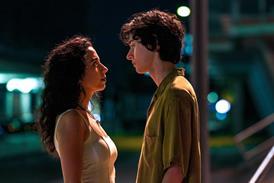
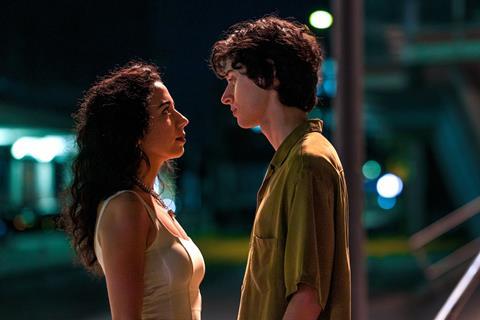
Farasha (Dawoud), one of five young sisters in a Syrian immigrant family living in Hamburg, attends her father’s grave on the eve of a school graduation party. The shindig takes place in a club atop Hamburg’s landmark television tower ‘Telemichel’ where, after exuberantly getting down to some Arabic-styled techno, Farasha encounters a half-Turkish boy named Faris (Eren M. Güvercin). Meet cutes are rarely so manifestly blessed by fate: the two have similar names, both plan to pursue science studies, both have intense eyes. But before long, a series of end-of-evening changes of plan, and a thunderstorm, lead to Faris waking the next morning in a hospital ward, not sure what’s hit him.
Even more dazed is Farasha, who has been killed in a terrible accident – as flashbacks reveal throughout the film. She is now a ghost, unable to contact the shaken, heartbroken Faris – until her late father informs her that the dead can contact the living in their dreams, but only for 40 days (viewers just have to go with this arbitrary rule, and most surely will). Over the following weeks (counted down in a series of slightly overwrought title cards), Farasha and Faris pursue what he wryly refers to as a ”long distance relationship”.
Fanciful as this conceit is, Akin carries it off beautifully, thanks to poetically shot representation of mundane city spaces – a dockside, a railway platform, deserted streets – venues for the couple’s hallucinatory trysts. Yet when Farasha realises that she shouldn’t try to hold on to Faris, the film takes on a more complex romantic agony – the agony of letting go of those you love, and of embracing life with all its accompanying heartache.
Radiant newcomer Dawoud gives her heroine both emotional and cultural complexity: Farasha is a serious-minded Muslim girl (the only female in her family who chooses to wear the veil, to the bafflement of her mother and sisters), but confident, independent and unrestrained in showing joy and desire whether on the dancefloor, or with Faris (some of their dream interludes, with fingers tenderly brushing flesh, discreetly suggest mutual sexual initiation, à la Romeo and Juliet). As the haunted Faris, seasoned young film and TV face Güvercin (known from the German adaptation of teen-angst series Euphoria) achieves a vivid rapport with his co-star, his brooding sensitivity and energy suggesting the long-term wherewithal to be considerably more than an emo-style heartthrob.
The film is in black and white, though originally shot in colour, and there is indeed a parallel colour version. Certainly in this version’s resonantly moody monochrome, Frank Griebe’s widescreen camerwork brings Hamburg alive, especially in the eerie nightscapes, with some scenes pushing a strong comic-strip stylisation (indeed, the film has spawned a graphic novel). The underwater flashbacks (which presumably demanded some heavyweight commitment from Dawoud), together with the vertiginous climax, generate authentic genuine nail-biting tension.
Most of all, though, the film targets the heartstrings, but with precision and control that are never manipulative, and that successfully eschew cuteness (we’ll allow Akin one scene with an animated butterfly tattoo). Strong upbeat musical content also features an accordion-backed showcase for Palestinian singer Aya Samra, adding to a rich cultural mix.
Production companies: Bombero International, Warner Bros. Film Productions Germany
International sales: Beta Cinema beta@betacinema.com
Producers: Fatih Akin, Herman Weigel
Screenplay: Ruth Toma, Fatih Akin
Cinematography: Frank Griebe
Editor: Andrew Bird
Production design: Seth Turner
Music: Malakoff Kowalski, Jugglerz
Main cast: Mariam Dawoud, Eren M. Güvercin, Carlotta von Falkenhayn, Gabriel-Winner Amorin