










Jason Isaacs, Ruth Wilson and Thomasin McKenzie also star in Zachary Wigon’s intense Cannes Un Certain Regard title
Dir: Zachary Wigon. US. 2026. 90mins
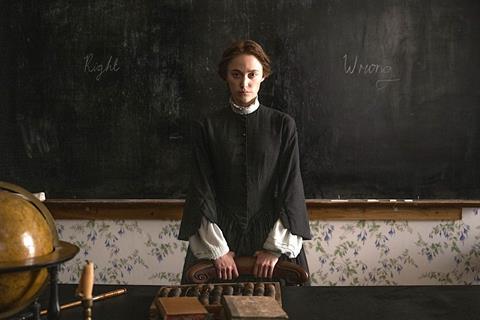
It’s 1858, and English governess Winifred Notty (Maika Monroe) arrives at sprawling mansion Ensor House in the wilds of the Yorkshire Moors. Everything initially seems as buttoned-up as you would expect from the period and the setting – but it’s not long before events descend into madness. The third feature from Zachary Wigon (following 2023’s Sanctuary and 2014’s The Heart Machine) takes gonzo delight in ratcheting up traditional gothic psychodrama tropes to frenzied heights while also paying striking homage to its literary roots.
Not so much Pride and Prejudice with zombies, but with Michael Myers
As suggested by its does-what-it-says-on-the-tin title, Victorian Psycho, which Spanish screenwriter Virginia Feito has adapted from her own 2025 novel, plays like an audacious mash-up of repressed 19th-century literary classics and bloody serial killer films like, well, American Psycho. Not so much Pride And Prejudice with zombies, but with Michael Myers. Premiering in Cannes Un Certain Regard, the film’s high concept and presence of stars Monroe (now something of a genre poster girl following Longlegs and It Follows), Jason Isaacs and Ruth Wilson should help it find an audience. Bleecker Street releases in the US, while True Brit will distribute in UK-Ireland.
“I’m the sanest person I know,” says Winifred early in her sparing narration – although that’s debatable from the outset. We first meet her as she rides through the countryside, framed at a woozy angle by cinematographer Nico Aguilar, her head weirdly cocked in the manner of myriad on-screen psychopaths. Still, when she arrives at Ensor House with her ironically Mary Poppins-esque carpet bag, she is keen to make a good impression. “This won’t be like the other times,” she insists to herself.
With her clipped British accent masking a Northern twang which slowly emerges as the film unravels, Winifred seems to fit in well with Mr Pounds (Isaacs), his wife Emily (Wilson) and kids Andrew (Hamnet star Jacobi Jupe) and Drusilla (Evie Templeton). There are, however, hints that things are askew – literally, in Aguilar’s off-kilter framing and disorienting camera movements. When Winifred finds an ear in her luggage and promptly swallows it –we get an ear’s eye view as it goes down her throat – the film has well and truly laid its cards on the table.
What follows is a riot, as Winifred, desperate to fit in with the Pound family for reasons that become clear, dispatches anyone who gets in her way. Both the filmmaking and Monroe’s deliciously gung-ho performance – far removed from her more understated characters in Longlegs and 100 Nights Of Hero – lean into the madness with glee. There’s lashings of blood, but the real chills come from the way in which Winifred’s fracturing psyche manifests itself physically; her jerky walk, her uncanny grin, her propensity to stare at people while they sleep. They may be familiar tropes, but they are used to full effect.
It helps that the film’s aesthetic favours realism, the hallucinatory violence grounded in authentic gothic detail. Production designer Jeremy Reed and costumer Allyson Byrne have dressed Ensor Hall and its residents in lush period drama familiarity (the grand family portraits, the velvet curtains, the bustles and pearls) but have added accents that hint at the film’s dark heart: looming tapestries featuring wild-eyed boars; lurid purple walls in an otherwise sombre hallway. Colour and light are used evocatively; the palette is mostly restrained and often silhouetted by candlelight, so that when vivid hues break through – such as Winifred’s shining moonlit face in a nighttime assignation, or her green dress in the nightmarish climax – they really make an impact.
Underneath all the mayhem, there are more insidious horrors at play – the yawning chasm of the class divide and the claustrophobia of a fiercely patriarchal society. The film pokes fun at these rich toffs, portraying them as simpering colonialist buffoons named such things as ’Mr Poncey-Fancey’. Such satire may be on the nose, but Issacs and Wilson do well to embody their characters with a straight-faced irony that emphasises their crassness without devolving entirely into caricature.
That Mr and Mrs Pound care not a jot for the fiery Drusilla’s education, giving all their attention to precocious son and heir Andrew, highlights the meagre status of women in this environment. Rich women have no choice but to marry and reproduce; poor women to live a life of servitude. Kindly nurse Miss Lamb (Thomasin McKenzie) – who is naïve enough to believe Winifred’s garbled explanation that a ‘ghoul attack’ is responsible for the blood stains on her collar – laments the easy cruelty of everyone above and below stairs.
There is nothing groundbreaking about these observations, but they do add an intriguing layer to Winifred’s behaviour. By throwing off the forced shackles of propriety, she is stepping outside the system, harnessing her darkness in a way that traditionally motivates male protagonists. It’s a far cry from the supposed mad women of classic literature, who were locked up or silenced for their hysteria – or, often, their progressive beliefs. In contrast, and for all its demented genre excess, Victorian Psycho plays like a welcome, cathartic primal scream.
Production companies: Traffic, Anton
International sales: Anton info@antoncorp.com
Producers: Dan Kagan, Zachary Wigon, Sebastien Raybaud, Liz Siegal, Nick Shumaker
Screenplay: Virginia Feito, based on her own novel
Cinematography: Nico Aguilar
Production design: Jeremy Reed
Editing: Dustin Chow, Lance Edmands
Music: Ariel Marx
Main cast: Maika Monroe, Jason Isaacs, Ruth Wilson, Thomasin McKenzie, Evie Templeton, Jacobi Jupe