








Kleber Mendonca Filho has poured his experiences growing up in Recife, northern Brazil into political thriller The Secret Agent. He talks to Screen about four key sequences in the film.
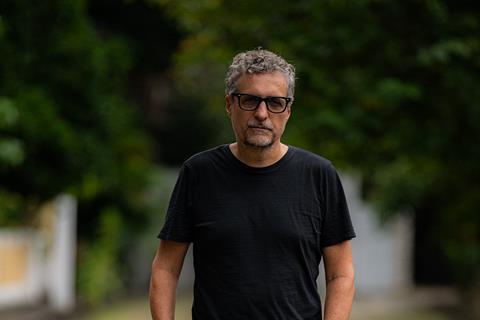
Brazilian writer/director Kleber Mendonca Filho’s The Secret Agent is a political thriller centring on Armando (Wagner Moura), a widowed academic and engineer attempting to flee his country’s military dictatorship with his young son in the late 1970s.
Nominated for two Baftas and four Oscars — the latter including best picture, leading actor and casting — The Secret Agent blends real events with Filho’s memories of growing up in Brazil, as well as celebrating many of his cinematic influences, including Steven Spielberg, Robert Altman, Abel Ferrara and Sam Peckinpah.
“The film comes from my own connection to Brazil and how I marvel at Brazil, and how I’m afraid of my own country,” says Mendonca Filho, a former film critic, from his home in Recife where The Secret Agent is set. “I’m 57. I grew up in Recife, and spent my teenage years in the UK. Then I came back. I loved living in the UK; I loved coming back. I have a healthy connection to Brazil. I don’t think it’s a toxic relationship. At the same time, it is a very peculiar culture, as is any country.”
The gas station
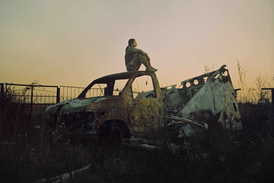
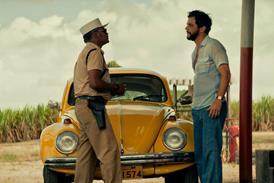
The scene: Armando (Wagner Moura) heads to his home city of Recife, during carnival season. Stopping his yellow VW Beetle for petrol, he spots a corpse near the pumps, covered by cardboard, before falling foul of a corrupt cop who eventually lets him go after an exchange of cigarettes.
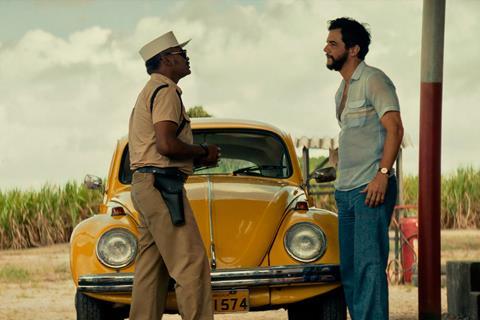
Kleber Mendonca Filho: “Being shaken down by cops is something that did happen to me in 1993 or maybe ’94. It was Ash Wednesday and they went through a checklist of everything that could possibly be wrong with my car. Didn’t find anything. Then, towards the end, they said, ‘Just give me something,’ which says a lot about a certain kind of corruption. It’s not extinct, but there is a type, petty little corruption, which I don’t really see happening anymore in Brazil.
“The logic of the film comes from cinema. It made me think of Wake In Fright [1971, directed by Ted Kotcheff] or some of the other great Australian films. I thought about Nelson Pereira dos Santos, a wonderful Brazilian filmmaker, and Peckinpah and Spielberg, Duel or The Sugarland Express. Nashville, with so many faces. Close Encounters [Of The Third Kind] is a weird influence for this film. I love how realistic it is, it’s very kind of working-class United States in the ’70s, but it’s also a fantasy film about aliens. All of that came in one package as I was writing the script and preparing the film. As well as Deliverance, that I screened for our wonderful DoP Evgenia Alexandrova.
“The idea of the body comes from a terrible story I read in the newspaper in the early ’90s. Rio de Janeiro has a freeway with three lanes, and a woman was struck by a car and the traffic never stopped; she was repeatedly run over until she disappeared. I saw this photograph from above and there was this long stain on the motorway. I was never able to forget that story.”
Restaurant brawl
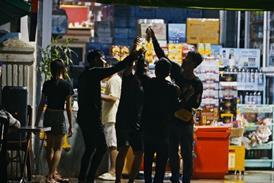
The scene: In flashback, Armando and wife Fatima (Alice Carvalho) have dinner with rich industrialist Ghirotti (Luciano Chirolli) and his “idiot son”. Ghirotti demeans Fatima who tells him to “go fuck himself”, causing a fistfight. As a result, Armando is forced into hiding.
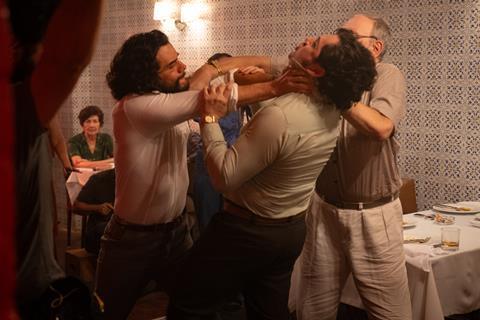
Mendonca Filho: “I looked at that scene almost like that gold idol in Raiders Of The Lost Ark when he goes inside the cave, and the cave has these booby traps. That’s the whole secret of the film. These two are not guerilla fighters with rifles and machine guns. This is a wonderful couple who did absolutely nothing wrong. But they had a problem with this guy, Ghirotti, who fancies himself as very powerful, comes from a different region, which is wealthier, and behaves like a white supremacist.
“They have a disagreement, which in the grand scheme of things could be described as small. But it’s not small. It’s epic. Because this guy and his son met two people who basically told them, ‘Go fuck yourself.’
“You shouldn’t say it every day, but there are moments in life when you should keep it as a special treat. And that’s when the audience goes, ‘Ha, I get it now.’
“It was all about building the tension in the dialogue, in the exchange. But it was tricky because this is a flashback and the audience parachutes into this situation. What you’re looking at has been going on for maybe half an hour, and so it was very important that once we cut to the situation, we cut to Fatima’s face and she looks distraught. There is clearly something very unpleasant going on. Then things escalate.
“We had wonderful discussions about that scene because the film was shot in 2024 and Alice Carvalho is a modern woman from the 21st century. I had to say, ‘Alice, Fatima is from 1977. She probably got married in ’71. She’s incredible, but she has to express herself in the way that a woman like her would 55 years ago.’ [Her character] says, ‘This is a man, this is a real man.’ And the way she remembers her own father: ‘That is a man.’ I don’t think those words would be used by a young woman in 2026. But they were used by my mother, when she said, ‘This is a man,’ about her father. Those little details give you not only the meaning of what it means for a woman to say, ‘This is a man,’ but a sense of period language.
The hairy leg
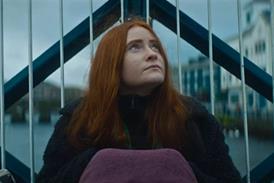
The scene: Thereza Vitoria (Isabel Zuaa), a neighbour of Marcelo — Armando’s alias while in hiding — reads aloud a news story about a mysterious, disembodied ‘hairy leg’ that beats up several people at night in a local park where Recife’s gay community congregates.
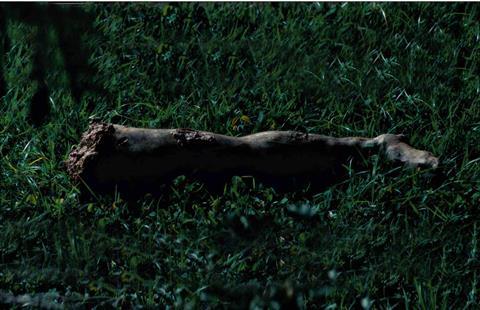
Mendonca Filho: “Recife is a very left-leaning city, irreverent, carnival is anarchic, it’s interesting from the point of view of cultural production, music, theatre, literature. But in the ’70s, the press was dealing with censorship and some themes were forbidden, particularly violence from the army, the police and the military police. So, when something happened, it wasn’t reported. Then, two journalists came up with the idea of a ‘hairy leg’. It was basically code for the police beating the shit out of people at night. These were usually bohemians. Maybe they looked like thieves. Maybe they were people from the gay community. Particularly in the parks, they took a beating.
“I grew up listening to stories about the ‘hairy leg’. My mother would read aloud from the newspaper just like Thereza Vitoria does in the film. That’s my memory of my mother reading it to me and my brother over breakfast, and my mother’s reaction was the same: ‘This is so odd. This is not in the literary section. This is in the metro section. How come?’ Because it took a while to adjust — the ‘hairy leg’ comes kicking from the dark and sends people to hospital.
“In the film it might feel a little jarring at first, but you will soon get the information that this is being read from the newspaper. The film has multiple layers of storytelling. It could be from the newspaper, from cassette tapes, drawings and oral history. One person telling something to another person, which is the last sequence in the film. That’s an oral history lesson, which is what my mother used to do as a historian. She used oral history as a major tool for research.
“The park sequence was also inspired by an erotic short story, published in the newspaper, which took place at the park. As an 11- or 12-year old, it was kind of transgressive to read. For many years, every time I drove by the park, I thought about that story. Then it all came back. When I was writing the sequence, I also thought about The Driller Killer by Abel Ferrara, because there are wonderful moments in it in the city and the park. Or maybe Ms. 45, another wonderful film by Ferrara. And The Warriors, of course. And Cruising by William Friedkin. These are parks-at-night movies. And I thought of Friday The 13th — something behind the bushes.”
The hitman chase
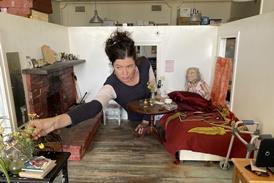
The scene: Cocky hitman Bobbi (Gabriel Leone) chases bleeding local hire Vilmar (Kaiony Venancio) through Recife’s downtown and is later killed in a barbershop by Vilmar.
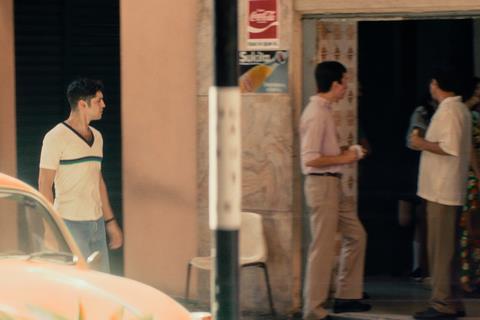
Mendonca Filho: “The whole thing about chases is you must give the right information to the audience. There is no point in just seeing people running if you’re not sure where they’re running to, where they’re coming from or what they’re trying to do. So, it all starts with my personal connection to that part of the city, which is right in the heart of downtown Recife. That’s where so many shops are either long gone or are still clinging onto the whole decadence of the city centre. But it’s an area I love. And I wrote the script salivating at the possibility of shooting there.
“For example, there is a small galleria with shops, which is where Bobbi dies, where the barber shop is. I love that place. That’s where my parents would take me to get my hair cut when I was a little kid and even as a teenager. All these places are part of my life.
“I still remember what the city centre used to sound like with the diesel and gasoline engines. PA systems turned up to the max. Street vendors screaming their products. All those sounds took many days’ work in the mix and in the editing. I found a tape that I shot in the late ’80s. I shot myself in the city centre on VHS and I got a lot of the sounds from those tapes. I was very lucky because one was just an hour of me walking, without saying anything, around the city centre. It was the perfect sound recording for the sequence.
“The street poet was interesting. I talked to him. I gave him like a minute idea of what the film is about. I said, ‘No comments on what I just told you. You are not a Greek chorus. We don’t need remarks on what is happening in the film. Just give me the craziest remarks about anything.’ And he did it so beautifully with such an amazing voice.
“Kaiony and Gabriel are consummate actors, which means they can be wonderful having a conversation, but they’re also amazing just moving from one side of the screen to the other, reacting, occupying the frame with their charisma. Kaiony’s got such an amazing face. I get so many reactions about Kaiony’s face and the way he behaves, and the way he answers, reacting to the attempt at negotiating his fee. Gabriel is also amazing. I saw him in Ferrari, Michael Mann’s film, and said, ‘Who’s this guy?’ And Emilie [Lesclaux, producer] says, ‘He is Gabriel Leone. He is Brazilian.’ He has charisma, screen presence. They both have what a film star is. You pay attention to them, but effortlessly.
“The Bobbi character, he’s very young. He is full of himself. He is mean-spirited and he’s also naive and inexperienced. That’s what gets him in trouble. And he’s also full of himself in a way that it’s almost like people from the south looking at people from the north. I’ve been to many screenings in Recife when Bobbi is shot and there is actual cheering in the cinema. Because the confrontation is between people from the south, the wealthier part of Brazil, and people from the north, which is where I come from. I never anticipated this, but the film plays with this internal tension.”






No comments yet