












![[Clockwise from top left]: Paul Thomas Anderson, Chloe Zhao, Ryan Coogler, Park Chan-wook](https://d1nslcd7m2225b.cloudfront.net/Pictures/274x183/9/0/0/1467900_writerdirectors_192733.jpg)
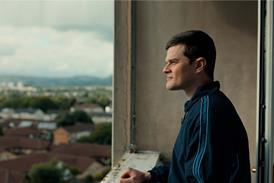


The key was to play the man and not the condition, the actor tells Screen.
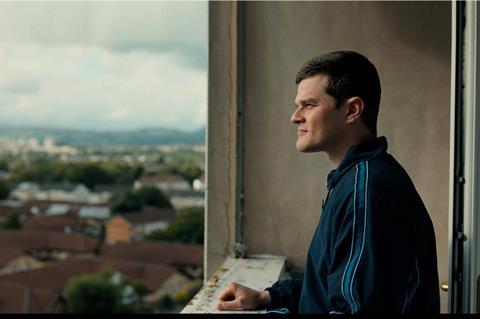
About a week before shooting began formally on UK comedy drama I Swear, star Robert Aramayo and director Kirk Jones got the cameras out for a trial period of near experimentation.
“We just had a skeleton crew,” remembers Aramayo. “We didn’t have much material to shoot, but we went out, put John in the world, and messed around and figured out certain things. The pressure was off, right at the beginning, so we could just play. I loved that, it was so creative.”
“John” is Aramayo’s role as John Davidson, a longtime Tourette’s campaigner who has been raising awareness of the condition in the UK since he was a teenager. Davidson developed a severe form of Tourette’s at the age of 12, initially baffling his family and school with his outbursts of inappropriate language and physical tics. He suffered social ostracism and rejection, leaving school at 16 with no qualifications, before a friend’s mother, Dottie (played by Maxine Peake in I Swear), helped him find a way through.
Davidson has endeavoured to raise awareness of Tourette’s in its many forms, via a series of documentaries and a lifetime of work. He has helped to ensure others with the condition have a far more extensive support network. The film premiered at Toronto International Film Festival and had grossed $7.9m (£6m) in UK and Ireland cinemas via Studiocanal at press time, with release in the US and multiple international territories to follow in 2026 courtesy of Sony Pictures Classics.
In the moment
To translate John’s story to the big screen, Aramayo and Jones quickly realised the only way to portray Tourette’s was to do so moment-to-moment. One day, early in the shoot, saw Aramayo’s John in a car with Andrea Bisset, a teenager who lives with Tourette’s. Her character Lucy and John trigger one another’s tics in a scene that was partially improvised, moving from initial greetings through awkwardness to a joyful sense of recognition in their shared experience.
The interaction helped Jones and Aramayo find the tone and the approach they needed: authentic, funny and very nearly heartbreaking. “Kirk and I spoke for a long time after shooting the scene about that tone and the fact our movie could hold something like that. The tone was always a conversation.”
But the director and actor also realised they could not plan too much. “Someone I absolutely love, who lives with Tourette’s, said to me, ‘The only thing that’s predictable about Tourette’s is that it’s unpredictable,’” says Aramayo. “At all times, I was trying to remember that. It had to surprise me, otherwise we’d lose the spontaneity.
“It’s impossible to copy John’s tics, because they’re influenced by environmental factors, by triggers, and what his anxiety levels are,” he continues. “I’d turn up for a very tic-y scene, then I’d say to Kirk, ‘I don’t think this is a tic-y day, for these reasons.’ Or, ‘This needs more tic-ing, because of these reasons.’ You have to be attuned to the circumstances and [John’s] experience at all times.”
The result is a performance that garnered a lead performance British Independent Film Awards (Bifa) nomination on the day Aramayo speaks to Screen International, which he went on to win.

The Yorkshire-born actor spent weeks with Davidson at his home in Galashiels, Scotland and spoke to other people with Tourette’s to channel the condition on screen. He tried to focus on the whole man and not only his symptoms. “I wanted to find John’s energy and make that the most important thing,” says Aramayo.
He and movement coach Alex Reynolds focused not on tics but the rest of Davidson’s life, “because that was hard enough. It’s his enormous heart. He is a hard worker with an amazing sense of humour.
From the word go, I knew my biggest challenge was to just try to inhabit this unbelievable human being.”
Several BBC documentaries about Davidson provided an insight into his physicality as a young man, and work with dialect coach Mary Howland helped Aramayo capture the Galashiels accent. “She really helped me. She has an incredibly high bar that’s never going to be met, and I love that so much. In any creative process, you always have to keep going and get better and better.”
Pushing himself is nothing new for Aramayo. As a teenager, he travelled from his home in Hull to New York, taking up a place at the Juilliard School to pursue acting after years in youth theatre. “I spent four very self-formative years there. The school instils in you a work ethic and a toolbox, which you might not understand now, but you might in 10 years. It’s constantly helping.”
He then landed a role in the final two seasons of Game Of Thrones as a young Ned Stark, and has enjoyed continued fantasy success as Elrond in Prime Video’s The Lord Of The Rings: The Rings Of Power, where his flowing robes and armour strike a change from Davidson’s tracksuits.
“I can tell you which one is comfier if you like,” laughs Aramayo when asked about season three, which he is shortly to wrap. “I don’t have the most difficult costume [in The Rings Of Power]; that would be my best mate Owain Arthur. I’m not sure what I’m allowed to say about this season. It’s an interesting one – I think people will like it. But I’m just so, so lucky to have worked on both Rings Of Power and I Swear.”
Aramayo can also be seen in Annemarie Jacir’s Palestine 36, Palestine’s submission for the international feature Oscar, playing a pro-Zionist British army officer. “Annemarie is an incredible director with a strong vision,” says Aramayo, who will spend the early new year at the Royal Court in London, starring in Guess How Much I Love You? for director Jeremy Herrin and actor-turned-playwright Luke Norris. It is his first stage role in 10 years, and part of his mission to keep that pressure on.
“I keep pushing myself. I know that when something scares me, I should do it,” he says. “I know that’s such a cliché, but it’s the right way to go about things, I think. If you don’t know how to do it, then do it, because that’s reason enough.






No comments yet