












Juan Manuel Sepulveda’s IDFA premiere focuses on three women residing in the camp
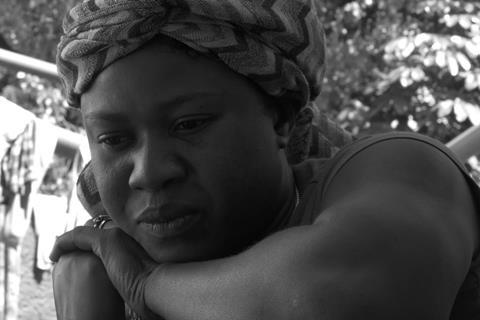
Dir: Juan Manuel Sepulveda. Mexico. 2026. 99mins
Unofficial, self-organised refugee camps have sprung up all over the world as migrants are forced to bide their time in countries that, for them, are waypoints rather than destinations. Mexican director Juan Manuel Sepulveda’s engaging new documentary embeds itself in one such tented community – set up by mostly Haitian migrants in one of Mexico City’s downtown squares, as its denizens wait to be summoned for US visa interviews.
Combines observational rigour with a clear sympathy for its subjects
Shot in a boxy 4:3 ratio, in an expressive black and white that seems to hark back to the Direct Cinema movement of the early 1960s, this is a film that combines observational rigour with a clear sympathy for its subjects. Although its subject is people in transit, stuck in a waiting room that is both geographical and existential, this is only tangentially a documentary about the migrant crisis. At its core is a fascinating, dynamic study of how people who have been brought together by chance live together, negotiate physical and emotional space, and preserve some privacy and dignity; this is the heart of the film’s audience appeal.
A black and white documentary about Haitian migrants in Mexico was never going to be an easy sell but, at the very least, Here Where the Fire Burns should further festival berths after its IDFA competition debut.
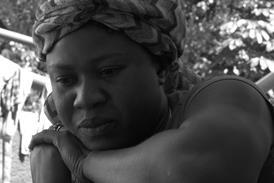
In a camp that appears to have some sort of all-male, presumably unelected steering committee that presides over the assignment of tents and other matters, the director chooses to focus on three women. Most prominent is Mani, a feisty, resourceful soul who has set up her own street food stall serving both camp residents and locals who live in the area. Big, proud, and declaredly free to love who she wants, she becomes the subject of gossip that for all its jokey tone, has a censorious, judgmental edge.
Delivered from the hands of the vicious drug cartels that ran the people smuggling operation they were forced to endure to get here, women like Mani are subject here to a different form of control. She has no problem pointing this out to Blanc, her over-possessive ‘camp husband’. These migrants – at least most of them – are smart, educated and politically engaged. Mani’s friend Wisena jokingly compares her fiery self-determination to that of 18th-century Haitian revolutionary and self-proclaimed emperor Jean-Jacques Dessalines.
The dreamy, unworldly nature of young bride Rose-Low, whose husband is elsewhere, somehow seems to protect her from all this, perhaps because she’s oblivious to it. Teenage Keisha, meanwhile, fixes her hair using a broken fragment of mirror before being sent with her friends to fetch water from a nearby fountain, piling the heavy jerry cans in a pushchair for the journey back to the camp. Locals, out walking their dogs, spare not even a glace for these refugee kids, as if they’re willing them to disappear.
The film’s double-edged title refers not only to the tinder-box nature of a camp where arguments flare, subside and flare up again, but to the square’s centrepiece – a statue of 16th-century Italian philosopher-priest Giordano Bruno, who was burned at the stake in Rome for his heretical views. In this place where the conversation always comes back to the status of one’s visa application, this hooded figure, who looks a little like a monastic Darth Vader, has been adopted as a tutelary saint. Mixing voodoo and Catholicism, supplicants burn incense at the statue’s feet, and hold their phones in the rising smoke.
There’s a nice moment when one of the camp residents complains about the arrival of a local TV crew with the words “Look, they’ve brought back the camera to bother us!” – which succinctly informs the audience just what an invisible, unthreatening presence Sepulveda’s camera is. When this migrant pop-up town comes to its inevitable end, we’re grateful to that camera for leaving a record of the life, hopes and energy that, for a few short months, filled Plaza Giordano Bruno.
Production company: Fragua Cine
International sales: Compania de Cine info@companiadecine.com
Producers: Juan Manuel Sepulveda, Mariana Mendivil
Cinematography: Juan Manuel Sepulveda
Editing: Pablo Gil Rituerto, Juan Manuel Sepulveda