


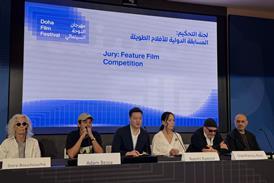



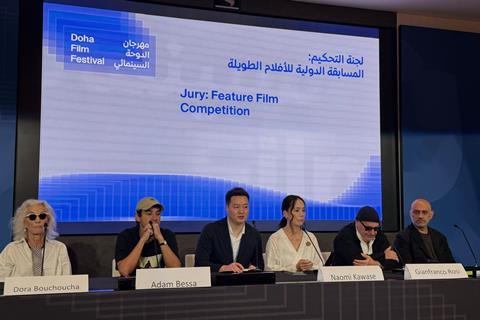
The programme of Doha Film Festival can act as an antidote to “flat” cinema from America, according to the festival jury on its opening day.
“Cinema is becoming very flat, conventional,” said Italian director and Doha jury member Gianfranco Rosi. “Without experimentation, cinema dies. I do documentaries, but I always try to break the boundary between documentary and fiction.
“I see more and more films that don’t have the courage to face the shaky world we are living in. It’s really important to have films that are able to look at this new reality that is forming around us, and find a new language to express it.
“Unfortunately, cinema has been on a flat level. American cinema invaded us with an idea of narration that has colonised the world. It’s important in this kind of festival to find narration through experimenting, and find a new answer to the problems in this moment in the world.”
Budget levels are getting out of control for major releases, said Rosi. “It is immoral to see that cinema belongs to the financial movement,” said the director. “You see movies that are financed with $500m, $600m, we don’t even know how much they are. I think this is completely killing cinema, and that’s what we have to fight.
Fellow juror, Palestinian filmmaker Kamal Aljafari, stepped in to note that “it’s not the case of this competition”, that the budgets are out of control.
“That’s why this festival is important; it’s why we can find a new way of making cinema,” added Rosi.
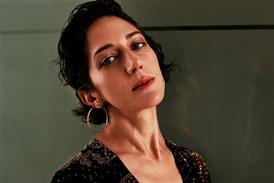
A homogeneity has even affected festivals, according to Tunisian producer and jury member Dora Bouchoucha. “We are in a time of standardisation, smooth films, and even in festivals they can have prizes,” said Bouchoucha, who has produced films including Morad Mostafa’s Cannes 2025 Un Certain Regard title Aisha Can’t Fly Away. “People who promote these films think that’s what the audience wants. It’s a pity because it is in this kind of festival, and festivals in general, that auteur films that are a bit difficult and make you think should be highlighted.”
Evolving
“Cinema is evolving. It’s getting more flat, but also getting extremely hard to find films,” said French-Tunisian actor Adam Bessa, also on the jury. “I know a lot of filmmakers, interesting people, but how do you find their films? That has changed. Everything is commercialised; art has become much more of an industry. The hard question is how artists can exist in a commercial world.”
Bessa, a 2022 Screen Arab Star of Tomorrow, spoke of being from “a generation where I discovered cinema through a computer”, in response to a question about the rise of AI in filmmaking. “Technology is what enabled me to be here. The question is how you use it. I saw a film that was completely created with AI. I don’t think people will watch this, people will always need the human impact.”
At the same time, “you cannot save everybody or look for everybody” in your audience, said Bessa. “Our role is to defend what we like and what we think is important for humanity.”
The jury is chaired by Japanese filmmaker Naomi Kawase, who addressed the ongoing US-Iran war that has seen missile strikes around the Arabian Gulf, including earlier this year in Doha. “From the bottom of my heart, I believe that we can take away war through cinema or art,” said Kawase via translation. “I want people to have a dialogue, understanding each other through these kinds of films.
“A lot of Japanese people think the area where we sit right now is dangerous. That’s not the whole case. Also as a woman, I think I can put some kind of diversity into these conversations, so we can push humanity to another level.”
Kawase recalled a conversation with Doha Film Festival director Fatma Hassan Alremaihi at Japan’s Osaka Expo 2025. “She told me that Arabic people and Asian people have different cultures, but if they could combine, it could bring a key to a peaceful world. I believe she is trying to achieve that, combining Asian and Arabic cultures and spirits. I’d like to achieve that as part of the jury.”
Rosi also criticised the amounts of money involved in awards campaigning, after his experiences with films including Fire At Sea. “It’s immoral when you have to pay $1m, $2m just to have your film shown in a campaign,” said Rosi of campaign costs. “Netflix, Amazon, all these big platforms, they invest so much money; then at the end, all the same films [are nominated]. In the Oscar campaigns, it starts with 400 or 500 films from all over the world, and at the end, there are always the same people. All the rest of the films are lost; this is a huge problem.”
The festival opens this evening with the MENA premiere of Sara Ishaq’s The Station; while the three-day industry programme began this morning with a talk by Hassan Al Thawadi, chairman of Qatar’s Film Committee.
Doha Film Festival runs until Friday, November 27.





No comments yet