










Venice Horizons title is visually assured exploration of adolescence against the tensions of contemporary Okinawa
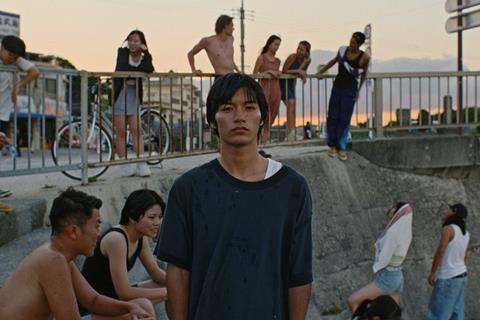
Dir/scr: Xavier Tera. Canada/Italy/Japan. 2026. 110mins
It’s the start of summer break on Okinawa Island, 2012. Teenager Kamei’s buddies have a packed schedule of loafing around, flirting, drinking and chucking themselves off bridges into the churning water below. But Kamei (Naoto Shimajiri), still processing the recent death of his father, stands slightly apart from it all. Then he meets Colin (West Mulholland), a yellow-haired kid raised on one of the American Air Force bases on the island. And although in some ways they couldn’t be more different, Kamei sees a reflection of himself in this brash, uprooted American adolescent. The handsome feature debut by Canadian director Xavier Tera treads the rocky terrain of coming of age and the first stumbling steps towards sexual awakening, mirroring that upheaval with a glimpse of wider tensions specific to Okinawa.
Xavier Tera is a striking visual stylist with an eye for elegantly expressive framing
Premiering in Venice Horizons, this is a thematically complex and ambitious project for a first feature from Tera, who cut his teeth as a photographer, artist and music video director. Some of the picture’s poetic imagery doesn’t entirely land – there’s a symbolic significance to Kamei’s unusual blue-yellow colour blindness, for example, but it takes a fair bit of laboured explanation to pin it down. But Tera, working with cinematographer Sayombhu Mukdeeprom (a regular collaborator of Luca Guadagnino and Apichatpong Weerasethakul), is a striking visual stylist with an eye for elegantly expressive framing.
The rich, sometimes overwhelming sensory onslaught evokes, rather effectively, the disorienting experience of being a gauche teenager at the heady, hormone-sodden brink of adulthood. It’s a sensual, drifting mood piece which should appeal to a similar audience to that of Eliza Hittman’s similarly sweat-soaked Beach Rats.
“The people you surround yourself with are a reflection of your future,” says Kamei’s grandfather, a man who has been conspicuous in his absence since the death of Kamei’s father but who still feels that he has the right to comment on his grandson’s life. This theme of mirrors and reflections is a potent one. It’s employed visually: there’s a terrific shot in which the grandfather’s disapproving countenance, captured as a reflection in a window, is superimposed over Kamei and Colin, shooting the breeze. And it is echoed in the writing: the two boys are both, it’s suggested, without fathers, and both drawn to the same girl, Kamei’s on-off girlfriend Sayaka (Yuma Taira).
For the grandfather, however, and like many of the older generation of native Okinawans (or Ryukyu), Colin represents an unwelcome presence. The Americans, with their simmering violence and the fighter jets that tear through the sleepy peace of the island, are viewed as colonisers. It’s ironic, perhaps, that while Kamei can’t wait to leave the place of his birth, Colin, who belongs nowhere, would spend his whole life there if he could.
Colour, as the film’s title suggests, is a central element, with the film’s lip-smacking, throbbingly saturated palette bringing pulsing life to scenes even when the laid-back Kamei is so energy-depleted that he seems nearly catatonic. The use of sound is another means to read the shuttered face of the central character: dictaphone recordings of Kamei’s late father’s work notes are woven into a soundscape that also includes the busy backdrop of birds and insects and the rumbles and growls of American military might. And while Kamei finds it hard to confide in his friends, a sparse voiceover takes the form of private messages to his dad, words which combine grief and loss with a hint of anger.
An ambient score blends with the picture’s sound design, while diegetic music is used to striking effect. Mangled ballads fill a grimly purgatorian karaoke bar where Kamei bonds with a sex worker twice his age. And late in the film, Fatboy Slim’s ’Right Here Right Now’ lifts a scene in which Kamei shakes off the weight of his grief and starts to dance again.
Production companies: Les Films TWIN BRAINS, Mia Film, Wise Pictures, bb²
International sales: The Pool Films, sales@thepoolfilms.com
Producers: Janie Chartier, Stella Rossa Savino Antonio Miyakawa Jeremy O. Harris
Cinematography: Sayombhu Mukdeeprom
Editing: Véronique Barbe
Production design: Rika Nakanishi
Music: Verses GT (Philippe Aubin-Dionne, Jason Chung Won)
Main cast: Naoto Shimajiri, West Mulholland, Ichiro Andre Castro, Daido, Yuma Taira, Shiyun Nakamura, Erika Oda, Sachiko Fukumoto