






The director and leading actress of Wicked and Wicked: For Good have been on an epic journey that has generated $1.2bn at the box office
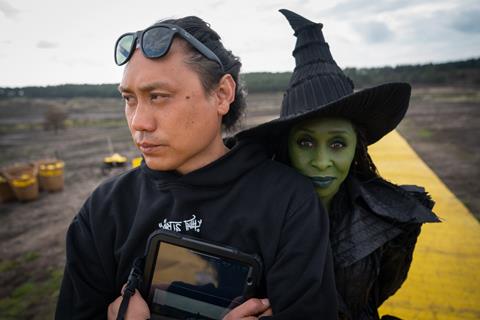
Director Jon M Chu and actress Cynthia Erivo have been on quite a journey together – not just to Shiz University and Emerald City, but a creative collaboration that has deepened over several years of preparing, shooting and releasing Wicked and Wicked: For Good.
Erivo plays Elphaba, alongside Ariana Grande’s Galinda/Glinda, in the origin story of witches from The Wizard Of Oz adapted from the stage play Wicked (in turn inspired by the book by Gregory Maguire). The second and final chapter of the story sees Elphaba exiled to the forest, trying to expose the truth about the Wizard, and still longing for connection with her friend Glinda.
The juggernaut double feature, produced by Marc Platt and David Stone and scripted by Winnie Holzman and Dana Fox, shot simultaneously from December 2022 to July 2023, with a few more days in January 2024 following the SAG-AFTRA strike. Wicked was released in November 2024, grossing $759m at cinemas worldwide, with For Good following a year later, reaching $442m at press time. Wicked earned 10 Oscar and seven Bafta nominations, winning for costume design and production design at both ceremonies.
“Wicked: For Good is the whole reason we made Wicked,” says Chu. “In this show, the fairy tale is part one, and then cracks just at the end of it. Part two is looking at the pieces after the fairy tale. Now that we know the truth, we’re headed into some unknown area – what are the pieces we are taking and where are we going? That is the whole message.”
The sequel also takes the audience more into the world of The Wizard Of Oz, with glimpses of Dorothy, her companions and the Yellow Brick Road. “I couldn’t believe we got to shoot Oz,” says Chu, still awestruck as a childhood fan of the 1939 classic.
Screen International: What do you think makes you two good collaborators?
Cynthia Erivo: Jon, do you remember the first conversation we had, even before we had a meeting about the project? That was the kernel of appreciation for the way one another works. We had a frank conversation. I think the thing that makes us good at collaborating is the way we listen and actually hear each other. We are constantly in conversation.
Jon M Chu: I think it was destiny, you hadn’t even come in to discuss the role yet. It was from the inside out, we got to talk about ourselves and our lives, not just about the project.
Erivo: It wasn’t always about work. We could see past the characters. I was unwell and getting home and Jon had sent me soup. He had made me this soup, without onions, because I’m allergic to onions and garlic.
Chu: My wife might have helped with the soup [laughs].
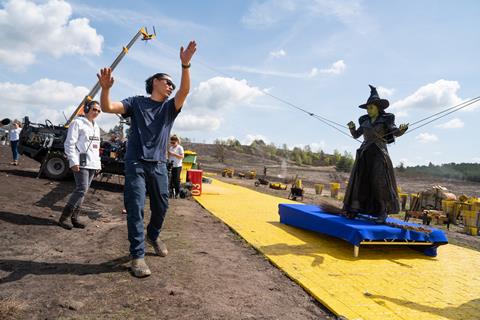
Cynthia, how did your process evolve in making these films? You had never been required to fly and sing simultaneously before.
Erivo: It became a physical process, outside of the emotional and mental process that I had to go through in order to be free enough. I had to know how physical I was going to be at any given moment, because there are a lot of stunts. I had to get my body ready for that and figure out how my voice works with all of that movement in the air.
Is there anything from that work you can take forward?
Erivo: It’s a body awareness from being in harnesses. The job that I’ve gone on to do [Gina Prince-Bythewood’s Children Of Blood And Bone] was all stunts. Now I have a point of reference for how my body might feel.
Chu: It’s not just stunts. It’s also her voice. She’s singing at the most dramatic levels. It’s like the physical levels of playing Batman or Iron Man and flip it instantly to be intimate and close to this character as you would in a small indie movie.
Jon, what did different actors need from you on the shoot?
Chu: We’re asking them to be emotionally available for us. I have to create the safe space for them to offer that. Of course, there are the lights, the costumes, but they can’t be thinking about that. The actors are the closest thing the audience has to the story. They are the direct connection. I need to make sure that space is clear.
And we would have exploration of every scene – digging it out, digging it out, digging it out, and trying different versions. That takes trust, because in post-production I need to be the one who’s communicating our conversations from those early rehearsal days to the shoot days, all the way to the edit room. That gets down even to mixing the sound. When Elphaba hugs Glinda, how heavy is that hug, how does the hug sound? Because I know what Cynthia was intending on that day.
Erivo: I watched him bend and move depending on what anyone needed on any given day. There were days where I needed to be left alone, where I needed quiet. That would be the day he would step to my side and hold my hand and just be in the space with me. Or there were days where I really needed to be pumped up, and he would be yelling from the camera and helping us get the next take.
Sometimes when I’m on a set, I get overstimulated, when there’s lots of voices going on, I can’t concentrate. Jon is the first person I told about that. Before, I had just been micromanaging it.
Elphaba is in exile for much of Wicked: For Good, so you are acting solo or with digital animals a lot. How did you approach that?
Erivo: It’s hard in general. I didn’t have all of the animals there, but I have beautiful performers who are doing movements and performing, who I can focus on, so that was helpful. But then there are moments where the animals aren’t there, and it’s Jon’s voice, and I just take that voice as truth. You just allow yourself to believe. There’s a voice telling me that I’m about to look at a snow leopard [for example].
Access to childhood imagination is helpful in those moments, because it allows you truly to believe what’s not there. So when you look in my eyes, you know that I’m seeing what you’re seeing, because that was my aim.
There’s something kind of wonderful about being solo, because the loneliness feels real. The solitude is real. There’s a wider scope for allowing the emotion to take up a lot more room than you would do if you were in a room with someone else.
How much were you thinking about some of the real world in relation to the story? Munchkinland’s travel restrictions could mirror Donald Trump.
Chu: The best thing about timeless stories is that they are timely, whether for good or bad. It’s a human thing, not even a political thing. It’s a human arc about people who take power. When we shot Boq [played by Ethan Slater] and the Munchkins getting kicked off the train, we hoped it felt like history, not current history.
This second film moves more into the world of The Wizard Of Oz. Were you both lovers of Oz in childhood?
Chu: The Wizard Of Oz was huge for me. My parents came from Taiwan and China to the United States. The Wizard Of Oz is the American fairy tale, the yellow brick road, the man behind the curtain that’s going to give you all your heart’s desire. This idea of the heart’s desire was important – you work hard and love what you do, and by the end, you’re going to be rewarded for that. When I saw Wicked on stage, I was midway through my film school and in Los Angeles for the first time, and all the stories my parents told me, there was a reality to them. I was questioning all those things. I was just at that moment [ready] to relook at our childhood stories and reassess them.
Erivo: Oz was a film that’s been in my life for a long time. We used to watch it as a family on weekends. It’s the first time I saw Judy Garland and fell in love with ‘Somewhere Over The Rainbow’. Now I think I have a secret obsession with finding all the different versions of that song and how people have sung it. I’ve sung the song myself.
Chu: We had grips and crew members in tears because you suddenly realise, we all are influenced a lot by The Wizard Of Oz. This is what made us want to work in movies or made us believe in movies.
This has been years of your lives working on Wicked. Do you have a favourite memory from this experience?
Chu: There are two moments. I will never forget watching Cynthia sing ‘No Good Deed’. She was alone against a blue screen. She has to evoke the end of her life, essentially. I watched this woman perform with the most extraordinary energy, offering the rage and the surrender to her own power. I did not know that song could be sung like that.
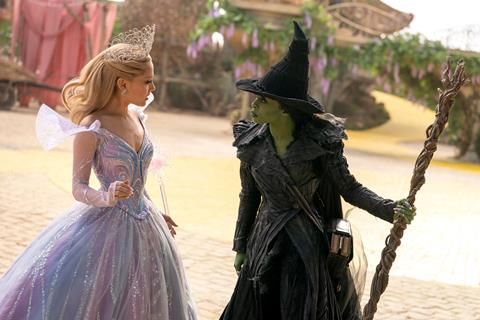
I also loved shooting [Elphaba/Glinda duet] ‘For Good’. These two women have the confidence to not go giant with it, instead to go true with it, go intimate with it. Even in rehearsals, I was weeping while watching their dynamic – that’s what the whole movie was.
Erivo: On ‘For Good’, that scene was one way in the script. Then Jon, Ari [Ariana Grande] and I had a chat about what it was that we really wanted from it. It changed and became this sweet moment of, “I’ve missed you. I wanted to come and see you.”
Does a huge project like Wicked change what you are driven to work on next?
Erivo: I have this hunger for roles that force me to transform completely, not just on the inside, but on the outside as well – projects that force me outside of myself totally. I want to keep doing that.
I want to keep challenging what it is that is necessary to show up. I love the challenge of having to push past contact lenses and push past green skin so people could see her as a three-dimensional human being.
If I can be that involved in how a character exists, then that’s what I want from future roles.
Chu: With Wicked, we didn’t have an answer from the beginning. We had ideas to go through a journey to get there. You have to silence all the critics and just focus on the work. I had to do that for years – as people questioned why it was two movies, why I was hired. We had to internally feel our own validation.
Being in that bubble was a huge lesson for me. We have all gone through ideas of how do we prove ourselves in this business, or prove ourselves in our country. Elphaba and Glinda gave me permission not to wait for that approval anymore. They create their own space. None of us are slowing down. I’m actually more energised by this experience.


No comments yet