














Writer/director Kisin Saito’s wilfully unpredictable drama bows in Tokyo’s Nippon Cinema Now programme

Dir/scr: Kisin Saito. Japan. 2026. 79mins
Debut writer-director Kisin Saito’s Kefi might seem to recall Hirokazu Kore-eda’s Our Little Sister; it is, after all, about three sisters who connect in the family home after the death of their divorced, now estranged father. Yet that’s where the comparisons end. Saito’s refreshingly irreverent and original family drama doesn’t always make a lot of sense, but stands out simply for being a reminder of how exciting cinema can be. Kefi will be divisive, but there’s little denying it’s eye-catching – and a noisy announcement of a welcome new voice in Japanese filmmaking.
Saito’s ambition and obvious fondness for the form are undeniable
Saito, who has previously worked as a cinematographer and who serves as his own DOP here (using the pseudonym Sigma Sudd), has broken ranks with other emerging filmmakers by jettisoning the grey wash, shallow depth of field and under-lit aesthetic that has become a hallmark of independent cinema. Festivals and art house distributors looking for the kind of jolt provided by directors such as Toshiaki Toyoda (2001’s Blue Spring) and Shinichiro Ueda (One Cut Of The Dead) may want to take a chance on KEFI following its world premiere in Tokyo’s Nippon Cinema Now strand. It should attract audiences looking for an alternative to Japan’s current wave of anime, soft focus romances and family dramedies.
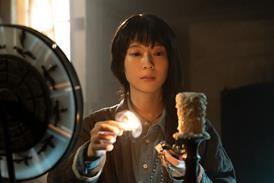
As stated in opening and closing title cards, the film is dedicated to Saito’s own father, who passed away in 2024 – and in many ways Kefi could be the director wrestling with his own feelings. The film is told in four parts, after an introduction to each of the three sisters by the ghostly voice over of their deceased father. Part 1, ‘Human,’ sees eldest daughter Kyo (Mari Iriki) meet up with a pair of aliens (played by Russian-born content creators Nikita & Danil) in a 1950s Americana diner and later head to a hotel where she drops a magic drug, Kefi, to partake in some body switching sex with an escort.
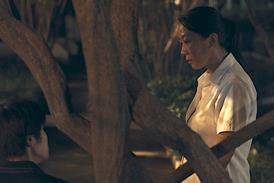
In Part 2, ‘Triangle,’ youngest sister Kino (Konatsu Kato) and her boyfriend Kai (Tone Kaiya) revisit some of the places Kino visited with her father when he was alive, with Kai taking a side trip to a shady dream clinic to get in touch with his inner self. The clinic is run by middle sister Asumi (Riho Takada), and she uses it to stay close with an old boyfriend – for whom Kai is a dead ringer. Part 3, ‘Punishment’, follows a washi paper maker (So Takei) having a felonious encounter with a tourist, which the aliens correct in their own way. The sister finally, briefly meet up in the final segment, ‘Reunion’. All of this happens on the same day.
If any of that makes Kefi sound like a straightforward narrative about grieving and searching for emotional reconciliation in the wake of a death… it’s not. In between moments with each sister, Saito throws in a possessed (maybe?) agent of the aliens, Rin (Koto Ishikawa); alternates between ultra-vivid colour and black and white images; embraces natural light; and toggles between roughhewn handheld camerawork and the more expected steady long shots – the kind of respectfully staid photography expected of a film about loss.
In mixing up his visual language, Saito also intertwines the perspectives of the sisters, overlapping them in a trippy and often inscrutable way that nonetheless allows his characters to express their grief – or lack thereof. Ultimately it’s an original creative choice that is honest in its willingness to suggest that death, or an individual’s response to it, is not always sad.
Saito’s storytelling is wilfully unpredictable; every time it seems he may go down an expected road he pivots in another direction, and frequently into dark comedy. A soundtrack of Japanese indie artists including Ålborg, hyou, Meg Bonus, The Bawdies and Qoodow, among others, signals a young, modern voice at the helm. Kefi is bold and occasionally hazardous but Saito simply bends the film to his will, demonstrating the confidence of a more experienced filmmaker. It’s not perfect, and Saito’s obvious indifference to the rules of filmmaking could be a sticking point for some, but his ambition and obvious fondness for the form are undeniable.
Production companies: Kuma Studio
International sales: Geta Films/Green Light, inquiry@getafilms.com
Producer: Nami Sekiya
Cinematography: Sigma Sudd
Production design: Kazusa Kanesada, Takayuki Houndki
Editing: Kisin Saito
Main cast: Riho Takada, Mari Iriki, Konatsu Kato, Tone Kaiya, So Takei, Nikita & Danil, Kazunori Mimura