













Nicholas Galitzine and Bill Skarsgård head this real-life tale from the ’Friday Night Lights’ and ’Lone Survivor’ director
Dir: Peter Berg. US. 2026. 127mins
Telling the true story of four US college football superstars who enlisted in the Second World War, The Mosquito Bowl is a gruelling experience – but not an especially enlightening or moving one. Director Peter Berg draws on his history with sports dramas (Friday Night Lights) and war films (Lone Survivor), sending these idealistic young men into combat where they learn that their patriotism and athleticism means little in the face of such inexpressable horrors. Nicholas Galitzine leads a likeable cast, who are fed into Berg’s ultra-macho, hyper-kinetic war scenes. In the process, the filmmaker flexes pummeling overkill rather than sincerely cataloguing his characters’ physical and psychological torment.
The film largely recycles combat cliches
After premiering at AFI Fest, The Mosquito Bowl opens in US theatres on October 30 before coming to UK screens two weeks later. This Netflix release hits the streaming platform November 25, and the picture could appeal to older audiences with a passion for football and war movies. Galitzine recently appeared in the commercially disappointing Masters Of The Universe ($114 million worldwide), and the ensemble also includes It and Nosferatu star Bill Skarsgård. But the betting is that most viewers will wait to watch this violent film, which is based on Buzz Bissinger’s 2022 book, from the comfort of home.
In 1941, America enters the Second World War following Japan’s bombing of Pearl Harbor. Among those inspired to join the fight are John McLaughry (Galitzine), Bob Bauman (Skarsgård), Tony Butkovich (Ray Nicholson) and David Schreiner (Tom Francis), who all play for elite college football teams and are familiar with each other’s immense onfield talent. They end up being part of the same Marine company that travels to Tarawa, then Guadalcanal and Okinawa, discovering firsthand the brutality of warfare as they try to stay alive.
Berg specialises in high-octane action, and here works with editors Jon Otazua and Garret Donnelly to ensure that the combat sequences have a pulverising intensity. The soldiers’ chaotic arrival on the beaches of Tarawa, bullets and blood flying before they even get out of the boat, invites comparisons to Saving Private Ryan’s similarly harrowing opening sequence. But Berg’s showboating tendencies get the best of him, turning a set piece that is meant to illustrate the characters’ naivety about war into a gaudy technical achievement shorn of any humanity. It will not be the first time that The Mosquito Bowl depicts combat like an elaborately choreographed fight scene, treating the Japanese forces as anonymous bad guys not worthy of the audience’s curiosity or compassion.
Similar to war films such as The Deer Hunter, The Mosquito Bowl introduces its characters as civilians so that we can appreciate their innocence before they are shipped off to combat. These athletes’ acumen on the field gives them an unearned confidence that their sheer determination will be enough to defeat the Japanese which Berg seeks to slowly erode, first during their punishing time at boot camp. But, whether in those sequences or later on the battlefield, the film largely recycles combat cliches. Equally as frustrating, The Mosquito Bowl shows no interest in exploring themes like masculinity, instead delivering a pro forma war film that pays lip service to tired notions of sacrifice, heroism and brotherhood.
The lead actors exude a stolid decency, mostly serving as sympathetic ciphers unprepared for the death and destruction they will soon witness. Galitzine is too blandly virtuous to reveal any layers to McLaughry, who has a loyal girlfriend waiting for him at home, while Nicholson and Francis are stuck dramatising a dull feud between their characters based on an old gridiron rivalry. These Marines do not appreciably change over the course of The Mosquito Bowl because they have no interior lives and so, when some characters meet a tragic fate, their death has no resonance.
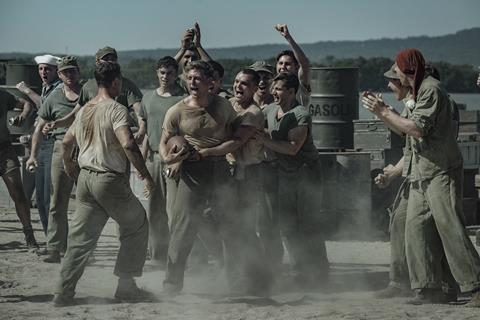
The Mosquito Bowl gets its name from an impromptu football game played in Guadalcanal by several former athletes-turned-soldiers and this unusual digression late in the film has the potential to reveal another side of these testosterone-driven men. But as with his war scenes, Berg conceives the game as just one more flurry of quick shots, flashy editing and mythologising slow-motion that is dispiritingly hollow.
Still, this lack of commentary is preferable to the moments in which the director unconvincingly tries to insert antiwar sentiments. Most risibly, Berg occasionally cuts from the carnage of the battlefield to shots of outer space in which we see Earth silently indifferent to the millions of lives snuffed out by the Second World War. But such grand pacifist messages ring false when, elsewhere, Berg seems sufficiently energised by the hell he’s unleashing.
Production companies: Imagine Entertainment, Film 44
Worldwide distribution: Netflix
Producers: Peter Berg, Brian Grazer, Alex Gayner
Screenplay: Peter Berg and Mark L. Smith, based on the book The Mosquito Bowl: A Game Of Life And Death In World War II by Buzz Bissinger
Cinematography: Jacques Jouffret
Production design: Phil Ivey
Editing: Jon Otazua, Garret Donnelly
Music: Explosions In The Sky
Main cast: Nicholas Galitzine, Bill Skarsgård, Ray Nicholson, Tom Francis, Brent Comer, Dominic Bogar