







Christos Houliaras’s Thessaloniki premiere stars composer-turned-actor Alexis Kalofolias
Dir: Christos Houliaras. Greece/Cyprus. 2026. 97mins
A man fleeing from his failures in Athens goes back to the village of his youth, where he’s confronted with a criminal case he just can’t let go in the fiction feature debut from director Christos Houliaras. This autumnal and chilly film, shot close to the Albanian border in muted colours, is an absorbing character study of a gruff man in an inhospitable environment.
A small but precision-tooled feature
Houliaras has worked as an assistant director for filmmakers including Costa-Gavras, Park Chan-Wook and Maggie Gyllenhaal, and has also made shorts and 2011 feature documentary Directing Hell. Carried with sullen grace by composer-turned-actor Alexis Kalofolias in the lead, Under The Judas Tree is a small but precision-tooled feature that could see some festival action following its Thessaloniki premiere, as well as on platforms interested in fictional crime dramas.
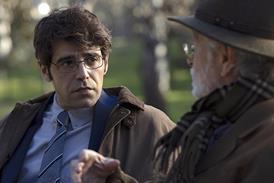
Elias (Kalofolias) arrives by bus to his ancestral village in the mountains, a place that is, in many ways, the opposite of the bustling Athens he has left behind — a city he now associates with failures both in the professional and personal arena. Back in the hamlet that doesn’t seem bigger than a few streets, his first stop is the home of Kostas (Yorgos Dabasis), the local policeman and an old friend, whose wife, the schoolteacher Vito (Eleni Vergeti), welcomes Elias with open arms. That said, neither seem particularly willing to talk much about specifics when asked how things have been since Elias’ last visit, several years ago.
Without much to do locally and with plenty of time on his hands, Elias becomes obsessed with the case of the corpse of a young woman found naked in the woods by Kostas. The victim has not been identified, and neither have an apparent motive or possible killer, and the police officer doesn’t seem much pressed to investigate the case – so Elias takes it upon himself to try and figure out what has happened. Houliaras, who co-wrote the film with George Zafeiropoulos, occasionally over-eggs his Greek pudding, especially with the repetitive visions of the victim that Elias keeps having. But mostly, this is a more subtle and unsettling work that crackles with an underlying tension as things slowly start to fall into place.
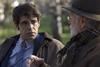
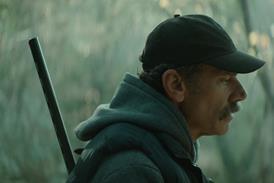
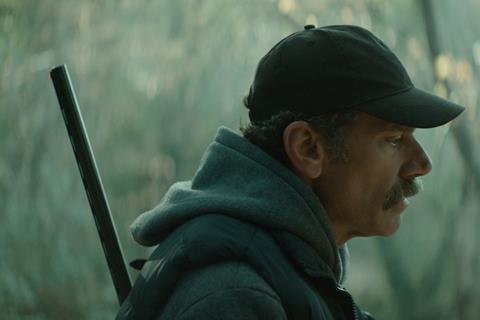
Houliaras is clearly a visual storyteller thinking in cinematic images. Elias and Kostas, for example, don’t have an enormous backstory but it’s clear that they are two very different people just from the way they look. Kostas, with cropped, wavy hair, is clean-shaven except for a Sam Elliott-worthy mustache, while Elias has unkempt longer hair and a stubble that’s been there longer than a few days. What makes things more complex is that their physical bearing doesn’t necessarily betray their moral backbone.
Shot in muted colours and in overcast weather, with trees nearly leafless and the terrace of the village café completely empty, the film has a forlorn, even clammy look. This strong and familiar sense of place in turn suggests something about why Elias would want to stay, despite everything that’s happening there. Kalofolias puts in a charismatic turn in the lead role, and the rest of the small cast is also solid; particularly Tasos Karlis, who gives a nerve-jangling turn as a troubled local youth.
Production companies: Marni Films, Caretta Films
International sales: Marni Films info@marnifilms.gr
Producers: Mina Dreki, Constantinos Nikiforou, Theodora Pikrou-Valentis, Panos Papadopoulos, Polymnia Papadopoulou-Sardeli, Sofia Dimopoulou, Yorgos Georgopoulos
Screenplay: George Zafeiropoulos, Christos Houliaras
Cinematography: Yannis Simos
Production design: Olga Sfetsa
Editing: Yorgos Georgopoulos
Music: Justin Sullivan, Stavros Makris
Main cast: Alexis Kalofolias, Yorgos Dabasis, Eleni Vergeti, Vasilis Siafis, Tasos Karlis